What Is This?
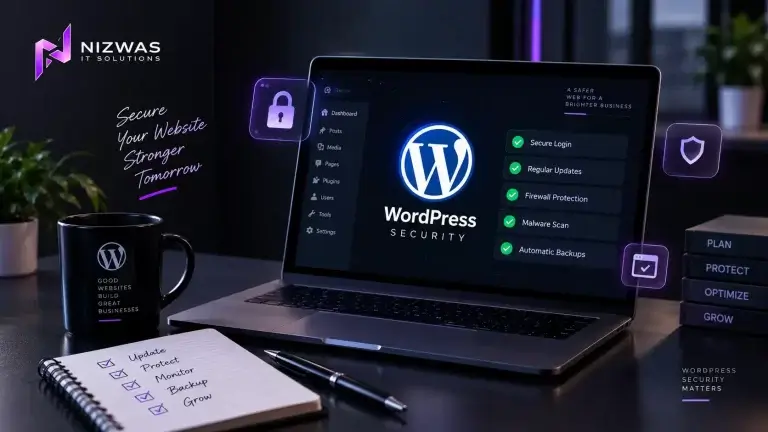
A WordPress Security Checklist is a practical list of security controls and maintenance tasks that help protect a WordPress website from unauthorized access, malware, vulnerable software, data loss, and avoidable configuration mistakes.
WordPress is a mature platform with an active security team, but that doesn’t mean every WordPress website is automatically secure. The security of your individual website also depends on your hosting environment, plugins, themes, administrator accounts, passwords, backups, server configuration, and ongoing maintenance. WordPress itself recommends a layered approach to hardening websites.
This guide turns those principles into 25 practical WordPress security checks that a business owner, developer, freelancer, or website manager can actually use.
Who Wrote It?
This article is prepared from a WordPress development, maintenance, security, performance, and technical SEO perspective.
At Nizwas IT Solutions, WordPress maintenance and security work includes core, theme and plugin updates, backups, malware protection, Cloudflare security configuration, SSL monitoring, database cleanup, firewall configuration, login protection, vulnerability scanning, and ongoing website monitoring.
What Will I Learn?
By the end of this guide, you’ll know how to:
- Secure WordPress administrator accounts
- Protect WordPress login
- Keep WordPress and extensions updated
- Create a dependable backup strategy
- Add firewall and malware protection
- Reduce unnecessary security risks
- Protect important WordPress files
- Monitor suspicious activity
- Prepare for a hacked website
- Create a repeatable security maintenance routine
Let Me Scan: The 25-Point WordPress Security Checklist
If you only have a few minutes, start here.
Account and Login Security
- Use strong, unique passwords
- Enable two-factor authentication
- Remove unnecessary administrator accounts
- Follow the principle of least privilege
- Protect login attempts
WordPress and Plugin Security
- Keep WordPress core updated
- Keep plugins updated
- Keep themes updated
- Remove abandoned plugins
- Remove unused themes
Backup and Recovery
- Maintain automated backups
- Keep an off-site backup
- Test your backups
Server and Website Protection
- Use HTTPS
- Configure a web application firewall
- Run malware scans
- Protect sensitive configuration files
- Use appropriate file permissions
- Disable unnecessary functionality
- Keep PHP and hosting software supported
Monitoring and Maintenance
- Monitor security logs
- Monitor uptime and unexpected changes
- Protect forms and user-generated content
- Review security after major changes
- Maintain a recovery plan
Now let’s go through each one.
Let Me Read: The Complete WordPress Security Checklist
1. Use Strong, Unique Passwords
Your WordPress administrator password is one of the first things an attacker may target.
Don’t use the same password for WordPress, email, hosting, your domain registrar, Cloudflare, or other business accounts.
If one service is compromised and the same credentials are reused elsewhere, multiple systems can become vulnerable.
Use long, unique passwords and consider a reputable password manager.
For business websites, administrator credentials should never be shared through email, chat messages, spreadsheets, or documents that are accessible to multiple people.
2. Enable Two-Factor Authentication
A password alone shouldn’t be your only protection for important accounts.
Two-factor authentication adds another verification step when someone signs in. Depending on the implementation, this can involve an authenticator application, security key, or another supported method.
Enable 2FA at minimum for:
- WordPress administrators
- Hosting accounts
- Domain registrar
- Cloudflare
- Business email
- Other critical services
This is one of the simplest improvements you can make to your WordPress security.
3. Remove Unnecessary Administrator Accounts
Review your WordPress users regularly.
If a developer finished a project six months ago and no longer needs access, remove the account or reduce its permissions.
If an employee changes roles, review their WordPress privileges.
Don’t allow everyone to have administrator access simply because it’s convenient.
4. Follow the Principle of Least Privilege
Give each user only the permissions necessary for their work.
For example, someone writing blog posts usually doesn’t need permission to:
- Install plugins
- Change themes
- Modify security settings
- Create administrators
- Edit server configuration
Limiting privileges reduces the potential impact of a compromised account.
5. Protect Your WordPress Login
Brute-force attacks can generate thousands of automated login attempts.
Useful protections include:
- Strong passwords
- Two-factor authentication
- Login rate limiting
- Firewall rules
- CAPTCHA where appropriate
- Monitoring failed login attempts
Security tools such as Wordfence provide controls designed to limit brute-force login attacks.
Don’t rely on hiding or changing the login URL as your main security strategy. It can reduce certain automated requests, but it isn’t a replacement for proper authentication and access controls.
6. Keep WordPress Core Updated
Updates aren’t just about getting new features.
WordPress releases security fixes when vulnerabilities are discovered.
For example, WordPress 7.0.3 and 7.0.4 were released in August 2026 with security fixes, including a high-impact vulnerability addressed in 7.0.4.
That is why leaving a production website on an old WordPress version for months is risky.
Before updating a business-critical website:
- Take a backup.
- Check plugin compatibility.
- Test on staging where practical.
- Update.
- Test the website.
- Check forms, checkout and important functionality.
7. Keep Plugins Updated
Plugins add functionality, but they also add code to your website.
A vulnerable plugin can become an entry point for an attacker.
Keep plugins updated and pay particular attention to plugins that:
- Handle user input
- Process uploads
- Connect to external APIs
- Handle payments
- Modify database content
- Add administrator functionality
For important websites, test significant updates rather than blindly updating everything directly on production.
8. Keep Themes Updated
Themes can contain PHP, JavaScript, CSS and other components that require maintenance.
Keep your active theme updated and review customizations carefully.
If you use a child theme, make sure your custom code is compatible with the updated parent theme.
9. Remove Abandoned Plugins
An inactive plugin isn’t automatically dangerous, but unnecessary software increases the number of components you have to maintain.
If you don’t need a plugin, remove it after confirming it isn’t required by another part of the website.
If a plugin has been abandoned by its developer and has no clear maintenance path, investigate a supported alternative.
10. Remove Unused Themes
The same principle applies to themes.
If your website has several old themes installed from previous redesigns, review them.
Keep what you actually need and remove unnecessary themes after confirming that they aren’t being used for recovery or other legitimate purposes.
11. Maintain Automated Backups
A secure website needs a recovery strategy.
Back up at least:
- WordPress files
- Database
- Uploaded media
- Important configuration
- Custom code
Your backup frequency should match how often your website changes.
A simple brochure website may need less frequent backups than an ecommerce store receiving orders throughout the day.
12. Keep an Off-Site Backup
Your only backup shouldn’t live on the same server as your website.
Imagine your hosting account is compromised and your attacker deletes the website and its backups.
You don’t want your recovery strategy to disappear at the same time.
Keep at least one separate, protected copy of important backups.
13. Test Your Backups
This is one of the most overlooked items in a WordPress security checklist.
A backup isn’t valuable simply because a plugin says “Backup completed.”
You need to know whether it can actually be restored.
Periodically test restoration on a staging environment or another controlled location.
Check that:
- Database restores correctly
- Images are available
- Plugins work
- Theme files are intact
- Important functionality works
- Forms work
- Ecommerce functionality works when applicable
A backup you can’t restore is not a reliable recovery plan.
14. Use HTTPS
Your website should use HTTPS with a valid SSL/TLS certificate.
Check that:
- HTTP redirects correctly to HTTPS
- Important pages don’t produce mixed-content warnings
- Forms work correctly
- Secure cookies are configured appropriately
- The certificate is valid
HTTPS is also part of broader technical website health and should be checked during ongoing maintenance.
Nizwas includes SSL/HTTPS monitoring as part of its website maintenance and security workflow.
15. Configure a Web Application Firewall
A Web Application Firewall, or WAF, can inspect and filter potentially malicious web traffic.
Depending on the configuration, it can help protect against:
- Suspicious requests
- Automated attacks
- Exploit attempts
- Malicious traffic
- Excessive abusive requests
Cloudflare provides WAF capabilities at the edge, while WordPress security solutions can provide application-level protection.
The important point is that a WAF should be properly configured for your website rather than simply activated and forgotten.
16. Run Regular Malware Scans
A hacked website doesn’t always look hacked.
Attackers can hide malicious code inside files, databases, administrator accounts or scheduled tasks.
Regular scans can help detect:
- Unexpected PHP files
- Modified WordPress files
- Suspicious redirects
- Spam content
- Unknown administrator accounts
- Malicious JavaScript
- Unexpected changes
If your website suddenly starts redirecting visitors, displaying strange pages, or generating spam URLs, investigate immediately.
17. Protect Sensitive Configuration Files
WordPress contains files that deserve additional protection.
wp-config.php, for example, contains important configuration information and database credentials.
You should also protect:
- Backup archives
- API credentials
- Environment files
- Private keys
- Database credentials
- Server configuration files
WordPress’s official hardening documentation specifically covers protection of important configuration files and recommends a layered security approach.
18. Use Appropriate File Permissions
Incorrect file permissions can create security problems.
Don’t blindly change everything to 777.
WordPress’s official documentation explains that permissions vary depending on the hosting and server setup, and warns about the dangers of overly permissive permissions.
The objective is simple:
Allow the access required by WordPress and your hosting environment — and no more.
If you’re unsure about permissions, ask your hosting provider or a WordPress developer rather than changing them randomly.
19. Disable Unnecessary Functionality
Every enabled feature should have a reason to exist.
For example, XML-RPC may be required by some integrations but unnecessary for others.
Don’t disable functionality just because you’ve read that it can be abused.
First determine whether your website depends on it.
The same principle applies to:
- REST API access
- File editing
- User registration
- Comments
- Unused integrations
- Unnecessary admin functionality
Security is about reducing unnecessary exposure without breaking legitimate functionality.
20. Keep PHP and Hosting Software Supported
WordPress relies on the wider hosting stack.
That includes:
- PHP
- Database software
- Web server
- Operating system
- SSL
- DNS
- CDN/WAF
Don’t keep a website on obsolete server software simply because “the website still works.”
A supported environment provides a better foundation for security and compatibility.
21. Monitor Security Logs
Logs can reveal activity that isn’t visible from the front end.
Look for:
- Repeated failed logins
- New administrator accounts
- Unexpected plugin changes
- Modified files
- Suspicious requests
- Firewall blocks
- Unusual API activity
You don’t necessarily need to manually read logs every day.
Automated monitoring and alerts can make the process much more practical.
22. Monitor Uptime and Unexpected Changes
Security and availability are closely connected.
A compromised website may:
- Become unavailable
- Redirect visitors
- Load unusually slowly
- Display spam
- Create unexpected pages
- Change content
- Send suspicious emails
Uptime monitoring and website-change monitoring can help you notice problems sooner.
Nizwas uses ongoing monitoring for website health, uptime, SSL status, performance and security as part of its maintenance approach.
23. Protect Forms and User-Generated Content
Forms are often overlooked.
Contact forms, registration forms, comments and other input fields accept information from users and automated bots.
Use appropriate:
- Input validation
- Sanitization
- Spam protection
- Rate limiting
- CAPTCHA where appropriate
- Access controls
Don’t assume that a simple contact form doesn’t need security considerations.
24. Review Security After Major Changes
Your website’s security profile can change after a major update.
Review your security after:
- Website migration
- Hosting migration
- Redesign
- New plugins
- New integrations
- WooCommerce installation
- Custom development
- DNS changes
- Cloudflare changes
- New administrator accounts
This is especially important after hiring a new developer or agency.
25. Create a WordPress Recovery Plan
Don’t wait until your website is hacked to figure out who has access to it.
Document:
- Domain registrar
- Hosting account
- Cloudflare account
- WordPress administrators
- Backup location
- Recovery process
- Developer/support contact
- DNS configuration
- Important third-party integrations
When something goes wrong, this information can save hours.
What Happens If Your WordPress Website Gets Hacked?
Don’t immediately start deleting random files.
First, understand what happened.
A sensible response is:
1. Preserve a backup or copy where possible.
2. Restrict access if the situation requires it.
3. Change compromised credentials.
4. Review administrator accounts.
5. Scan website files and database.
6. Check recently modified files.
7. Identify vulnerable plugins, themes or code.
8. Review server and security logs.
9. Remove malicious code or restore clean files.
10. Update vulnerable software.
11. Check for spam pages and malicious redirects.
12. Monitor the website after recovery.
If you’re dealing with a serious compromise, don’t experiment on the live website. Preserve evidence and involve someone experienced with WordPress incident response.
Why WordPress Security Also Matters for SEO
Website security isn’t only a technical issue.
It can affect your search visibility and reputation.
Google specifically documents hacked content as a search-quality problem. Attackers may inject spam pages, malicious JavaScript, hidden links, content or redirects into compromised websites.
Google also documents cases where malicious hacking can introduce redirects or manipulated canonical signals.
That means a security incident can potentially create problems far beyond the website itself.
A compromised website can lose:
- Visitor trust
- Leads
- Revenue
- Search visibility
- Brand reputation
- Time spent cleaning the website
This is why security belongs alongside technical SEO, performance and website maintenance.
Nizwas’s technical SEO service includes security, HTTPS, crawlability, indexing, performance, structured data and ongoing technical monitoring as parts of broader website health.
WordPress Security Is a Process, Not a Plugin
One of the biggest misconceptions about WordPress security is:
“I installed a security plugin, so my website is secure.”
A security plugin can be useful.
But it can’t compensate for:
- Weak passwords
- Outdated software
- No backups
- Insecure hosting
- Excessive administrator access
- Poor file permissions
- Abandoned plugins
- Exposed credentials
- No monitoring
- No recovery plan
WordPress security works best as layers.
Think about it like this:
Strong accounts → Updated software → Secure hosting → Firewall → Malware monitoring → Backups → Recovery plan
If one layer fails, the others still provide protection.
How Often Should You Review Your WordPress Security?
A practical maintenance schedule could look like this.
Daily or Automated
- Uptime monitoring
- Critical security alerts
- Backup status
- Malware alerts
Weekly
- Security scan
- Update review
- Failed-login review
- Backup verification
Monthly
- User account review
- Plugin inventory
- Theme inventory
- Hosting/PHP review
- Security configuration review
Quarterly
- Full security audit
- Backup restoration test
- Access review
- Firewall review
- Recovery-plan review
For ecommerce, membership, healthcare, financial or other high-value websites, a more rigorous security process may be appropriate.
Nizwas WordPress Security & Maintenance
For businesses that don’t want to manage WordPress security manually, ongoing maintenance can provide a more reliable approach.
Nizwas IT Solutions provides WordPress maintenance and security services covering:
- WordPress core updates
- Plugin and theme updates
- Backups
- Malware monitoring and removal
- Cloudflare configuration
- Firewall protection
- Login protection
- SSL/HTTPS monitoring
- Database cleanup
- Performance optimization
- Vulnerability scanning
- Website monitoring
- Post-update testing
The maintenance process also includes testing after updates rather than simply applying updates and walking away.
Explore Nizwas WordPress Maintenance & Security Services
For businesses concerned about the relationship between security, speed and search visibility, Nizwas also provides technical SEO audits covering crawlability, indexing, HTTPS, Core Web Vitals, server response, structured data and other technical areas.
Explore Nizwas Technical SEO Services
Your Final WordPress Security Checklist
Before you finish this article, check these 25 items:
- Strong, unique passwords
- Two-factor authentication
- Unnecessary users removed
- Least-privilege access
- Login protection
- WordPress core updated
- Plugins updated
- Themes updated
- Abandoned plugins removed
- Unused themes removed
- Automated backups
- Off-site backup
- Backup restoration tested
- HTTPS enabled
- WAF configured
- Malware scanning
- Sensitive files protected
- File permissions reviewed
- Unnecessary functionality reviewed
- Supported PHP and hosting stack
- Security logs monitored
- Uptime monitored
- Forms protected
- Security reviewed after major changes
- Recovery plan documented
You don’t need to complete all 25 in one afternoon.
Start with the fundamentals: protect your accounts, update your software, create reliable backups, secure your hosting, monitor the website, and know how to recover it.
Then make security part of your normal WordPress maintenance routine.
A secure WordPress website isn’t created by installing the maximum number of security plugins.
It’s created through good configuration, responsible access control, timely updates, reliable backups, monitoring and consistent maintenance.
What Should I Do Next?
If you’re managing a WordPress website today, start with these seven actions:
1. Check your administrator accounts.
2. Enable 2FA.
3. Update WordPress, plugins and themes.
4. Verify your backups.
5. Confirm HTTPS is working correctly.
6. Check firewall and malware protection.
7. Document your recovery process.
If several of these are missing, don’t wait for an attack before fixing them.
Prevention is usually much easier than recovering a compromised business website.
Frequently Asked Questions
A WordPress Security Checklist is a practical list of tasks used to reduce security risks, protect accounts and website files, maintain backups, monitor threats, and prepare for recovery.
Start with strong unique passwords, 2FA, updated WordPress software, reliable backups, HTTPS, firewall protection, malware scanning, appropriate permissions and secure hosting.
WordPress has an active security team and a formal process for identifying and fixing vulnerabilities. However, individual websites still need secure hosting, updated plugins and themes, strong authentication, backups and ongoing maintenance.
A security plugin can provide useful firewall, scanning and login-protection features, but it isn’t a complete security strategy. Website security also depends on hosting, credentials, updates, backups and configuration.
Your backup frequency should match how frequently the website changes and how much data you can afford to lose. An ecommerce website generally needs a more frequent backup strategy than a simple informational website.
Yes, particularly for administrator and other high-privilege accounts. 2FA provides another layer of protection if a password is compromised.
Not automatically. Some websites and integrations require XML-RPC. First determine whether your website uses it before disabling or restricting it.
Secure compromised accounts, preserve a backup or copy where possible, investigate the infection, scan files and databases, identify the entry point, remove malicious content, update vulnerable software and monitor the website after recovery.
Yes. Attackers can inject spam pages, redirects, malicious code and hidden content. Google specifically documents hacked content and malicious redirects as problems that can affect search results and users.
For a typical business website, a detailed review every quarter is a useful baseline, combined with automated monitoring and security checks after major changes.