Part 1: The Short Answer — There Is No Magic Number
If you’re a local business owner, you’ve probably heard numbers like 10, 50, 100 or even 500 Google reviews being presented as the number you need to rank.
The truth is much more useful than that.
There is no fixed number of Google reviews that guarantees a higher Google ranking in 2026.
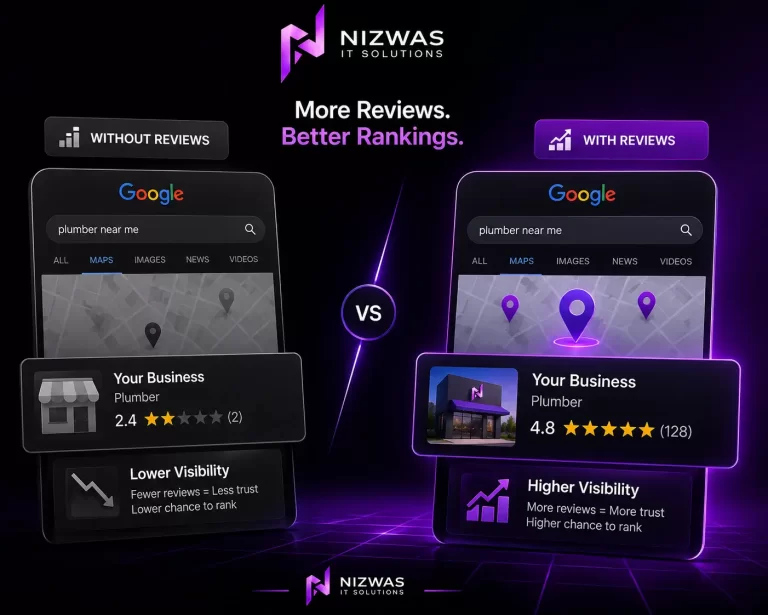
Google’s own guidance says local results are mainly determined by three things: relevance, distance and prominence. Reviews contribute to prominence, and Google specifically says that more reviews and positive ratings can help a business’s local ranking.
That means a business with 30 reviews can outrank a business with 150 reviews.
It sounds strange, but consider two businesses competing for the same local search:
- Business A has 150 reviews but an incomplete Google Business Profile.
- Business B has 45 genuine reviews, a highly relevant category, accurate business information, strong local content and a location closer to the searcher.
Business B can still appear higher.
So the better question isn’t:
“How many Google reviews do I need?”
It’s:
“How many reviews do I need to compete with the businesses already ranking for my target searches?”
That’s the number that matters.
A practical 2026 benchmark
Although there is no universal threshold, review counts can still provide useful competitive benchmarks.
For many smaller local markets, getting your first 10 genuine reviews is an important credibility milestone. Moving toward 25–50 reviews can make a profile look substantially more established.
In competitive markets, however, you may find businesses with 100, 200, 500 or even thousands of reviews competing for the same searches.
Recent third-party 2026 analyses demonstrate just how dramatically this can vary by industry and location. One analysis of thousands of highly ranked local businesses found substantial differences between categories, with review counts in competitive industries reaching hundreds or more.
The lesson is simple:
Don’t chase an arbitrary number. Study your actual competitors.
Part 2: How Google Reviews Affect Local SEO in 2026
Google reviews don’t operate as a standalone ranking switch.
They are part of a much larger local search system.
Google describes local ranking around three primary concepts:
1. Relevance
Relevance asks:
“How closely does this business match what the person is searching for?”
For example, imagine someone searches:
A business specializing in WordPress development is more relevant than a general business that happens to have a website.
Google recommends providing complete and detailed business information so it can better understand what a business offers.
This means your:
- Primary category
- Secondary categories
- Services
- Business description
- Website content
- Business information
- Location information
all matter.
Reviews can reinforce that relevance naturally when customers describe the services they actually received.
For example:
“They rebuilt our WordPress website and significantly improved the loading speed.”
That’s far more useful than dozens of reviews that simply say:
“Great service!”
You shouldn’t tell customers what keywords to put in their reviews. Reviews need to represent genuine experiences. But naturally detailed customer feedback can give potential customers useful context.
2. Distance
Distance is another major part of Google’s local ranking system.
Google considers how far a business is from the person searching. If the searcher doesn’t provide a location, Google uses available location information to estimate where the search is coming from.
This is one reason why a business can’t simply collect hundreds of reviews and expect to dominate an entire city.
A business can have:
- 500 reviews
- a 4.9-star rating
- an excellent website
and still not appear prominently for someone searching from a location where another relevant business is much closer.
Reviews help, but they don’t erase geography.
3. Prominence
This is where reviews become especially important.
Google describes prominence as how well-known a business is. It says prominence can be influenced by information across the web, including links, articles and directories, as well as the number of reviews and review score.
This is why review acquisition should be part of a broader local SEO strategy.
Think about prominence as a collection of signals rather than a single score:
Reviews + website authority + local mentions + business information + overall reputation
The exact internal weighting is not publicly disclosed by Google.
That’s important because you’ll often see articles claiming that reviews represent an exact percentage of Google’s algorithm.
Treat those numbers cautiously.
Google has not published a public formula that says something like:
“Reviews = exactly X% of your ranking.”
Third-party surveys and studies can provide useful observations, but they shouldn’t be confused with Google’s own ranking documentation.
Do More Reviews Automatically Mean Higher Rankings?
No.
This is probably the biggest misconception about Google reviews.
Imagine:
Business A
- 200 reviews
- 4.2 stars
- last review 10 months ago
- weak website
- incomplete services
- wrong category
Business B
- 65 reviews
- 4.8 stars
- reviews arriving consistently
- excellent Business Profile
- strong website
- accurate categories
- strong local relevance
Business B may be much more competitive.
This is why review quantity should never be your only SEO KPI.
Part 3: How Many Reviews Should Your Business Actually Aim For?
Instead of using a generic number, use a competitive review benchmark.
Here’s a simple process.
Step 1: Choose your primary local keyword
Start with the search your customers are most likely to use.
For example:
- plumber in Toronto
- dentist in Manchester
- SEO agency in Delhi
- electrician in Melbourne
- restaurant in Austin
- WordPress developer in London
Don’t start with your business name.
You want to understand how your business performs for non-branded searches.
Step 2: Check the Google Map Pack
Search your primary keyword and location.
Look at the businesses appearing in the local results.
Record:
| Competitor | Reviews | Rating |
|---|---|---|
| Business A | 42 | 4.7 |
| Business B | 68 | 4.8 |
| Business C | 91 | 4.6 |
Now you have something much more useful than a generic internet benchmark.
Your market’s review landscape.
Step 3: Calculate the competitive gap
Suppose you have:
18 reviews
and your three primary competitors have:
42, 68 and 91 reviews.
You clearly have a review gap.
But don’t interpret that as:
“I need 92 reviews before Google will rank me.”
That’s incorrect.
Instead, think:
“My review profile is currently considerably weaker than the businesses Google is already showing for this search.”
Your first target could be reaching 30–40 reviews.
Then reassess your rankings.
Once you’re competitive, continue building reviews naturally rather than stopping at a specific number.
Step 4: Look at review quality
Count isn’t everything.
Compare:
- Average rating
- Review length
- Recency
- Genuine customer detail
- Customer experiences
- Responses from the business
A profile containing 80 detailed, genuine customer experiences can communicate much more trust than one containing 200 repetitive one-line reviews.
Google itself encourages businesses to value honest and balanced reviews and respond to customers.
A useful benchmark framework for 2026
These aren’t Google ranking thresholds. They’re practical planning ranges.
0–4 reviews:
Your profile has very little social proof.
5–10 reviews:
You have established a basic review presence.
10–25 reviews:
You’re beginning to look established compared with a brand-new business.
25–50 reviews:
A reasonable competitive target for many smaller local businesses.
50–100 reviews:
A strong review base in many markets.
100+ reviews:
Potentially competitive in moderate markets, but still not necessarily enough in highly competitive cities.
200+ reviews:
Common among established businesses in highly competitive local markets.
The important part is what comes after these numbers:
Compare yourself with your actual competitors.
A 30-review business may be dominant in one town and invisible in another.
Part 4: Review Velocity, Rating and Recency Matter Too
If you’re trying to improve your local visibility in 2026, don’t obsess over the lifetime review count.
Look at the health of your review profile.
Review velocity
Review velocity simply means the pace at which you receive new reviews.
For example:
Business A
100 reviews total
0 new reviews in the last six months
Business B
65 reviews total
4–6 new reviews every month
The second profile demonstrates ongoing customer activity.
Several 2026 industry analyses emphasize that review recency and a steady flow of new reviews are important considerations alongside total volume.
Don’t interpret this as a recommendation to manufacture review volume.
The goal is simply to make requesting legitimate customer feedback part of your normal business process.
How often should you ask for reviews?
There is no official Google rule saying you need exactly five reviews per month or ten reviews per week.
Your review pace should reflect your actual customer volume.
A business serving 20 customers a month shouldn’t suddenly generate 100 reviews.
Instead, build a simple system:
Customer completes service → Follow-up → Review request → Customer leaves genuine feedback
Consistency is much more sustainable than occasional campaigns.
Does the star rating matter?
Absolutely.
Google explicitly states that more reviews and positive ratings can help local ranking.
But don’t chase a perfect 5.0 at all costs.
A genuine business may receive:
- 5-star reviews
- 4-star reviews
- 3-star reviews
- occasional negative reviews
That’s normal.
Trying to remove every negative review simply because it isn’t five stars can create bigger problems.
Google’s policies prohibit businesses from discouraging negative reviews or selectively soliciting only positive reviews.
The better strategy is:
Deliver a good service → request honest feedback → respond professionally → improve where necessary.
Should you respond to Google reviews?
Yes.
Google recommends responding to reviews and explains that replies can help businesses build relationships with customers. It also recommends keeping responses professional, relevant and reasonably concise.
A response doesn’t need to be a paragraph.
Instead of:
“Thank you so much for your amazing five-star review! We really appreciate your kind words and hope to serve you again soon!”
Try something more specific:
“Thank you, Sarah. We’re glad the website migration was completed smoothly and that your team had everything ready before launch.”
That’s more human.
Never buy Google reviews
This deserves its own section.
Buying 50 five-star reviews might look tempting when a competitor has hundreds.
Don’t do it.
Google explicitly prohibits paid reviews, incentivized reviews, fake engagement and manipulated ratings. Businesses can face restrictions if Google determines that fake-review activity has occurred.
Possible consequences include:
- Fake reviews being removed
- Existing reviews being unpublished
- Restrictions on receiving new reviews
- A warning appearing on the Business Profile
Google has also described using automated systems to identify suspicious activity and fake-review patterns.
The safest review strategy is boring:
Ask real customers.
Part 5: The Best Google Review Strategy for 2026
If you want more Google reviews and stronger local visibility, build a process instead of chasing a number.
1. Make the review request easy
Google allows businesses to create a direct review link or QR code.
You can share it through:
- Thank-you messages
- Receipts
- Chat interactions
- Printed QR codes
Google specifically recommends these methods for making review requests easier.
The easier the process is, the less likely customers are to forget.
2. Ask at the right time
Don’t wait six months.
Ask when the customer has just experienced the result of your service.
For a web development company, that might be:
Website launched → Client approves project → Review request
For a restaurant:
Customer finishes meal → Thank-you message → Review request
For a home service:
Job completed → Customer confirms satisfaction → Review request
Timing matters because the experience is still fresh.
3. Don’t tell customers what to write
This is important.
Don’t send:
“Please give us a 5-star review and mention our SEO services.”
Instead:
“If you have a moment, we’d really appreciate an honest review about your experience working with us.”
Google’s policies prohibit encouraging specific content or manipulating ratings.
Let customers use their own words.
4. Respond to every legitimate review
Positive or negative, respond professionally.
For positive reviews:
Thank them and mention something specific.
For negative reviews:
Acknowledge the concern and offer a constructive next step.
Never argue with customers publicly.
Remember that your response isn’t only for the person who wrote the review.
Future customers are reading it too.
5. Improve your Google Business Profile at the same time
Reviews are only one part of local SEO.
Your profile should also contain accurate:
- Business name
- Category
- Address or service area
- Phone number
- Website
- Opening hours
- Services
- Business description
- Photos
Google recommends providing complete and detailed information to help it understand the business and match it with relevant searches.
Then make sure your website supports the same positioning.
If your Google Business Profile says you’re a WordPress development company, but your website barely mentions WordPress development, you’ve created an unnecessary relevance gap.
6. Build local authority beyond reviews
Don’t make Google reviews your entire local SEO strategy.
Work on:
- Local landing pages
- Service pages
- Location pages where genuinely useful
- Local citations
- Relevant backlinks
- Digital PR
- Industry directories
- Helpful content
- Internal linking
- Technical SEO
- Website performance
- Strong conversion pages
Google’s own explanation of prominence notes that information from across the web, including links, articles and directories, can contribute to how well-known a business is.
That’s why the strongest local SEO strategy combines reputation + relevance + authority + proximity.
So, How Many Google Reviews Do You Need in 2026?
If you want one practical answer:
Start with 10. Aim for 25–50. Then benchmark yourself against the businesses ranking for your most important local searches.
If your competitors have 40 reviews, getting to 50 may put you in a much more competitive position.
If your competitors have 250 reviews, 50 probably won’t close the gap.
And if your business operates in a very competitive industry, you may need significantly more.
The number isn’t the destination.
Competitive relevance is the destination.
The businesses that win local search aren’t necessarily the ones with the largest review count.
They’re the businesses that combine:
Genuine reviews + strong ratings + recent customer feedback + complete Google Business Profiles + relevant websites + local authority + good customer experience.
That is the approach worth building in 2026.
FAQs
There is no fixed number. Google says reviews are part of prominence, but local rankings also depend on relevance and distance.
It can be enough in a low- or moderately competitive market, but there is no guarantee. Compare your review count and overall profile with the businesses currently ranking for your target searches.
Yes. Google states that review count and positive ratings can help local ranking. Reviews are particularly relevant to Google Maps and local search visibility.
Positive ratings can help local ranking, according to Google. However, rating is only one part of the overall local ranking system.
Neither should be considered in isolation. Review quantity and positive ratings both contribute to prominence, while relevance and distance also influence local rankings.
Ask genuine customers for honest feedback and make the process easy using Google’s review link or QR code. Google explicitly supports these methods.
No. Google prohibits paid, incentivized and fake reviews and can apply restrictions to businesses involved in fake engagement.
There is no official monthly target. A consistent flow of genuine reviews that reflects your actual customer activity is a better approach than sudden artificial spikes.
Naturally descriptive reviews can provide useful context about the customer experience, but businesses should never instruct customers to insert specific keywords. Reviews should reflect genuine experiences.
Yes. Google does not rank businesses based on review count alone. Relevance, distance and prominence all contribute to local results.