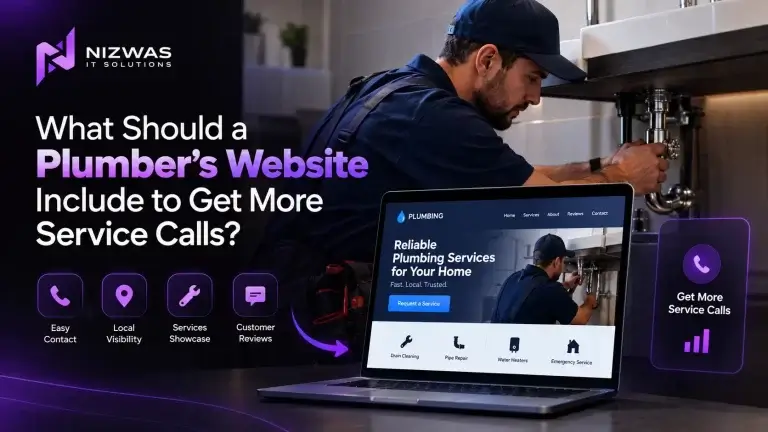
Plumber Website: The Real Goal Is More Calls, Not Just a Better-Looking Site
A plumber website should do more than display your company name, services, and a few photographs.
When someone searches for a plumber, they usually have a problem they want solved.
Maybe a pipe is leaking. The water heater has stopped working. A drain is backing up. A toilet will not stop running. Or there is water coming through the ceiling and they need help immediately.
In that situation, the customer does not want to spend ten minutes figuring out how your website works.
They want three things:
“Can you solve my problem?”
“Do you serve my area?”
“Can I trust you enough to call?”
That is why a successful plumbing website needs to combine clear services, local visibility, trust signals, strong calls to action, mobile usability, and solid technical SEO.
Google’s current guidance also emphasizes helpful, reliable, people-first content and making expertise and trust clear to visitors.
This guide explains the most important elements a plumber website should have if the goal is not simply traffic, but qualified service enquiries and phone calls.
What You Will Learn
By the end of this guide, you will understand:
- What pages a plumbing company website should have
- How to structure plumbing services
- Where phone numbers and calls-to-action should appear
- How to build customer trust
- Why mobile design is critical for plumbers
- How local SEO fits into the website
- How to use service-area pages correctly
- Which plumbing keywords should be targeted
- What technical SEO elements should be checked
- How to turn website visitors into actual enquiries
Quick Checklist: What Should a Plumber Website Include?
Before going into detail, here is the short version.
A strong plumber website should include:
- A clear homepage
- Dedicated plumbing service pages
- Prominent click-to-call buttons
- Clearly defined service areas
- Emergency plumbing information
- Reviews and trust signals
- Real photographs and team information
- Strong contact and booking options
- Local SEO and technical SEO foundations
Now let’s look at why each one matters.
1. A Homepage That Immediately Explains What You Do
Your homepage is often the first place a potential customer lands.
The first screen should answer the most important questions without making the visitor scroll.
For example:
Professional Plumbing Services in Orlando, FL
Fast, Reliable Plumbing Repairs for Homes and Businesses
Call Now | Request Service
That is much more useful than:
Welcome to ABC Plumbing. We are proud to provide quality services to our customers.
The second version sounds pleasant, but it does not tell the customer enough.
A good plumber website should communicate:
- What you do
- Where you work
- Who you serve
- What makes you different
- How customers can contact you
Your phone number should be highly visible, particularly on mobile devices.
A visitor should not have to open the menu, find the contact page, and then search for your phone number.
What to place above the fold
Consider including:
- Business name
- Primary plumbing service
- Service area
- Short value proposition
- Phone number
- Request-service button
- Emergency service option, if genuinely offered
Then move into your major services.
For example:
Drain Cleaning | Water Heater Repair | Leak Detection | Pipe Repair | Sewer Services | Emergency Plumbing
Each service should lead to a dedicated page.
This gives customers a faster route to the service they actually need.
2. Create Dedicated Plumbing Service Pages
One of the biggest mistakes we see on service-business websites is putting every service into one generic page.
A plumbing company may offer:
- Drain cleaning
- Water heater repair
- Water heater installation
- Leak detection
- Pipe repair
- Sewer line repair
- Toilet repair
- Faucet repair
- Emergency plumbing
- Gas line services
- Tankless water heater installation
Putting all of that into one page makes the website harder to navigate and limits your ability to target specific searches.
Instead, build individual pages around important services.
For example:
/drain-cleaning/
/water-heater-repair/
/leak-detection/
/emergency-plumbing/
/sewer-line-repair/
A dedicated page can explain:
- What the service involves
- Common signs of the problem
- When professional help is needed
- What customers can expect
- Your service process
- Areas served
- Frequently asked questions
- How to request service
This also creates a much stronger foundation for plumber website SEO because each page has a clear search intent.
Nizwas takes a similar structural approach when developing business websites, with content architecture, navigation, calls to action, internal linking, and SEO considered as part of the website build rather than added afterward.
3. Make Calling Your Business Extremely Easy
A plumbing website can have excellent content and still lose customers if contacting the business is difficult.
Think about the customer experience.
Someone searches:
“emergency plumber near me”
They visit your website.
They see a beautiful homepage.
They scroll.
They read your company history.
They scroll again.
They finally reach the contact page.
By that point, they may already have called another plumber.
For plumbing businesses, the phone is often one of the most important conversion channels.
Your website should therefore make calling simple.
Add click-to-call buttons
On mobile:
Call Now
Request Emergency Service
Get Plumbing Help
These buttons should be obvious without overwhelming the page.
You can also place the phone number in:
- Header
- Hero section
- Service pages
- Emergency service sections
- Footer
- Contact page
- Mobile sticky bar
Don’t hide the number inside an image.
Use actual HTML text so visitors can tap it and so search engines can understand the information.
4. Show Exactly Where You Provide Plumbing Services
Local customers want to know whether you actually serve their location.
A good plumber website should clearly communicate its service area.
For example:
Serving Orlando, Winter Park, Kissimmee, Sanford and surrounding areas.
But don’t create dozens of almost-identical location pages simply by changing the city name.
Each useful location page should have genuinely local information.
You could discuss:
- Services available in the area
- Neighborhoods or communities served
- Common local customer needs
- Service availability
- Directions or service logistics where appropriate
- Local projects or experience
- Relevant FAQs
Google Business Profile allows service-area businesses such as plumbers to define the areas they serve. Google currently allows service areas to be specified by cities, postal codes, or other areas rather than simply drawing a radius.
Your website and Business Profile should therefore communicate accurate information.
Google also states that a Business Profile can help service businesses appear on Google Search and Maps and lets businesses provide information such as hours, phone numbers, websites, services, photos, and reviews.
For more guidance, your website can link visitors to Google’s official Google Business Profile documentation.
5. Build Trust Before Asking for the Call
A homeowner is allowing a stranger into their property.
That means trust matters.
Your website should answer the questions a customer is silently asking:
Are these people legitimate?
Are they experienced?
Do other customers recommend them?
Will they actually show up?
Do they work in my area?
Can I contact them if something goes wrong?
This is where trust elements become important.
Include real trust signals
Depending on what is genuinely true for your business, include:
- Years in business
- Licenses
- Certifications
- Insurance information
- Professional memberships
- Warranty information
- Service guarantees
- Real customer reviews
- Before-and-after photographs
- Real team photographs
- Business address, where appropriate
- Service areas
- Emergency availability
- Financing information, if offered
Don’t invent claims.
If you say “24/7 emergency plumbing,” the business should actually provide that service.
If you say “licensed plumbers,” provide accurate licensing information where appropriate.
Google’s people-first content guidance specifically encourages making the experience, expertise, background, and authorship behind content understandable to visitors.
For a company website, this means your About page should not be an afterthought.
You can also link your About page from your blog author information to reinforce who is behind the content.
6. Put Customer Reviews Where They Actually Help
Reviews are important because customers often compare several businesses before choosing one.
Don’t create a review page and expect everyone to visit it.
Bring relevant reviews into the customer journey.
For example, your water heater page could contain a short customer testimonial about a water heater repair.
Your emergency plumbing page could feature feedback from a customer who needed urgent assistance.
Your homepage could show several recent reviews.
The key is relevance.
Don’t fake reviews
Never manufacture testimonials.
Don’t change the wording to make a customer sound more impressive than they actually were.
Don’t use stock photographs and present them as customers.
Trust is easier to build when the information is genuine.
Google Business Profile also provides businesses with tools to collect and respond to customer reviews.
7. Make the Website Excellent on Mobile
This is one of the most important parts of modern plumber website design.
A customer looking for a plumber may not be sitting at a desktop computer.
They may be standing in a kitchen with water leaking underneath the sink.
They may be outside a rental property.
They may be searching from a phone while trying to find help quickly.
Recent local-search research from BrightLocal found that most local searches are conducted on mobile devices, while 84% of consumers surveyed had searched for a local business online within the previous three months.
Your mobile experience should therefore prioritize:
- Large readable text
- Fast loading
- Simple navigation
- Click-to-call buttons
- Short forms
- Clear service categories
- Easy-to-read reviews
- Properly sized images
- Sticky contact options
- No intrusive popups
A beautiful desktop website is not enough.
Test the actual mobile experience.
Open the site on several phones.
Try calling.
Try submitting the form.
Try finding the emergency service.
If any of those actions feel difficult, fix the problem.
Nizwas also emphasizes responsive design, performance, Core Web Vitals, and mobile usability when developing and optimizing WordPress websites.
8. Create an Emergency Plumbing Page If You Offer Emergency Service
Emergency plumbing deserves its own page when it is a genuine service.
The search intent is different from someone researching a bathroom renovation.
Someone searching for an emergency plumber wants immediate clarity.
Your page should explain:
Emergency Plumbing Services
- What situations you handle
- Areas covered
- How customers can contact you
- Whether service is available after hours
- What customers should do while waiting
- What happens when the plumber arrives
Keep the call-to-action visible.
For example:
Need Emergency Plumbing Help? Call [Phone Number]
The page should not turn into a long essay.
The customer needs answers quickly.
You can also build supporting content around genuine customer questions:
- What should I do if a pipe bursts?
- How do I shut off my home’s water supply?
- What should I do if my water heater is leaking?
- When should I call an emergency plumber?
- How much does emergency plumbing cost?
These articles can support your service pages through internal links.
9. Build the Website Around the Searches Customers Actually Make
Keyword research is useful, but don’t treat it as a list of words to repeat throughout the website.
The better approach is to map keywords to the pages that satisfy the corresponding intent.
Several current third-party plumbing keyword studies identify strong demand around searches such as plumber near me, emergency plumber, plumbing services, water heater repair, drain cleaning, leak detection, and sewer line repair. However, the exact search volume varies considerably by country, city, keyword database, and date.
That distinction matters.
A keyword showing 100,000 searches globally does not mean your plumbing company will receive 100,000 searches in your city.
A practical keyword map
| Website Page | Keyword Theme |
|---|---|
| Homepage | plumber, plumbing company, plumbing services |
| Emergency Plumbing | emergency plumber, emergency plumbing |
| Drain Cleaning | drain cleaning, drain cleaning service |
| Water Heater | water heater repair, water heater installation |
| Leak Detection | leak detection, water leak repair |
| Sewer Services | sewer line repair, sewer repair |
| Service Area | plumber in [city], plumbing services [city] |
| Contact | plumber near me, local plumber |
| Blog | plumbing problems, homeowner questions |
The most important point is search intent.
A person searching “water heater repair” needs a service page.
A person searching “why is my water heater leaking?” may need an educational article.
A person searching “best plumber in Orlando” is comparing businesses.
Those searches should not all lead to the same page.
10. Use Local SEO as Part of the Website Strategy
A plumber website does not operate independently from the rest of your online presence.
Your website, Google Business Profile, reviews, local mentions, service areas, and other legitimate business listings should tell a consistent story.
Google explains that local businesses can establish their business details across Search and Maps by claiming their Business Profile.
Your website should clearly establish:
Who you are → What you do → Where you operate → How customers contact you
Your Google Business Profile should accurately reflect the same business information.
Your website should also have useful internal links between related pages.
For example:
Homepage → Plumbing Services → Water Heater Repair → Water Heater Repair in [City] → Contact
This gives visitors multiple ways to continue their journey.
Nizwas’s own local SEO guidance emphasizes the importance of clear location information, dedicated service pages, internal linking, local content, technical SEO, and appropriate structured data rather than simply adding city names to pages.
11. Don’t Forget Technical SEO
You can have the best plumbing content in your city, but technical problems can still prevent your website from performing properly.
Your website should be checked for:
- HTTPS
- Mobile responsiveness
- XML sitemap
- Correct robots.txt
- Proper canonical URLs
- Indexable service pages
- Clean URL structure
- 404 errors
- Redirect problems
- Broken internal links
- Page speed
- Core Web Vitals
- Image optimization
- Structured data
- Search Console configuration
Google’s LocalBusiness structured-data documentation explains that structured data can help Google understand business information such as details about the business, and Google recommends validating structured data before deployment.
Schema should not be treated as a magic ranking button.
It is simply one part of making your website information easier for search engines to understand.
If your WordPress site has indexing problems, our guide Why Is My WordPress Website Not Showing on Google? covers common issues such as noindex, robots.txt, canonical URLs, redirects, and Search Console diagnostics.
For more technical work, see Nizwas Technical SEO Services.
12. Your Contact Form Should Ask the Right Questions
A contact form shouldn’t become an obstacle.
For a plumbing business, a useful form might ask:
Name
Phone Number
Service Needed
Property Location
Preferred Date/Time
Brief Description of the Problem
Keep the form short.
For urgent plumbing situations, the phone should remain the primary option.
A good layout might be:
Need a Plumber?
Call [Phone Number]
or
Request Service Online
[Short Form]
The visitor should never wonder what to do next.
13. Show Your Plumbing Work
Real photographs can make a significant difference to trust.
Use photographs of:
- Your team
- Service vehicles
- Completed plumbing work
- Water heater installations
- Pipe repairs
- Drain cleaning
- Equipment
- Before-and-after projects
- Your business location, where appropriate
Avoid filling the website entirely with generic stock photographs.
A homeowner wants evidence that the business actually performs the work.
If possible, build simple project stories:
Water Heater Replacement in [City]
The Problem: Customer had inconsistent hot water.
The Work: Existing system inspected and replaced.
The Result: New system installed and tested.
This kind of content can demonstrate experience far better than a generic paragraph saying:
We are experts in all plumbing services.
14. Add Helpful Plumbing Content That Customers Actually Search For
Your blog should not exist simply because every business website has a blog.
Use it to answer questions your customers genuinely ask.
Examples include:
- Why does my toilet keep running?
- How often should drains be cleaned?
- What are the signs of a water leak?
- How long does a water heater last?
- Should I repair or replace my water heater?
- What causes low water pressure?
- How do I know if I have a sewer line problem?
- What should I do before a plumber arrives?
- How much does plumbing repair cost?
- What causes a faucet to keep dripping?
This content can introduce potential customers to your business before they are ready to call.
But don’t turn every article into a sales pitch.
Google’s guidance recommends content created primarily to help people, with useful, complete information and demonstrated expertise, rather than content created mainly to attract search-engine traffic.
That principle is particularly important for local service businesses.
15. Give Visitors a Clear Next Step
Every important page should have a purpose.
At the end of a service page, don’t simply write:
Thanks for reading.
Tell the customer what to do.
For example:
Need Professional Drain Cleaning?
Our team can inspect the problem and recommend the appropriate solution.
Call [Phone Number]
Request Service
Or:
Not Sure What Plumbing Service You Need?
Contact our team and explain the problem. We’ll help you determine the appropriate next step.
This is where the website moves from being an information source to becoming a business tool.
The Ideal Customer Journey
A high-performing plumber website should make the customer journey feel natural:
Google Search
↓
Service or Helpful Article
↓
Relevant Plumbing Service
↓
Trust Signals
↓
Service Area
↓
Call / Request Service
↓
Qualified Lead
That is much more valuable than simply trying to rank the homepage for every plumbing keyword.
What Pages Should a Plumbing Company Website Have?
For a new plumbing business website, I would normally start with a structure like this:
Core Pages
- Home
- About
- Plumbing Services
- Service Areas
- Contact
Service Pages
- Emergency Plumbing
- Drain Cleaning
- Water Heater Repair
- Water Heater Installation
- Leak Detection
- Pipe Repair
- Sewer Line Repair
- Toilet Repair
- Faucet Repair
Only create pages for services the business genuinely offers.
Supporting Content
- Plumbing FAQs
- Customer Reviews
- Plumbing Blog
- Projects/Case Studies
- Financing, if offered
- Warranty information, if applicable
The exact structure should depend on the company’s actual services, market, competition, and customer journey.
How Much Does a Plumber Website Need to Focus on SEO?
SEO should be built into the website, but SEO should not make the website uncomfortable to read.
Don’t write:
Looking for a plumber? Our plumber services are provided by plumbers for plumbing customers looking for a plumber.
That is not useful.
Instead, write naturally:
Our team provides residential plumbing repairs throughout Orlando and nearby communities. From leaking pipes and clogged drains to water heater problems, customers can contact us for professional service.
The keyword is present.
The location is clear.
The service is clear.
And most importantly, a real person can read it comfortably.
This is the difference between optimizing a website and writing for a search engine.
What Makes a Plumber Website Convert Better?
If we reduce everything in this article to the essentials, the strongest combination is:
Visibility
The business needs to be discoverable through relevant local searches.
Relevance
The visitor needs to immediately see that the company handles their particular problem.
Trust
The website needs evidence that the business is legitimate and experienced.
Convenience
Calling or requesting service needs to be simple.
Speed
The site needs to work quickly, particularly on mobile devices.
Clarity
The customer should never wonder what to do next.
These elements work together.
A website that gets traffic but doesn’t generate calls has a conversion problem.
A website that converts well but receives no relevant traffic has a visibility problem.
A successful plumber website needs both.
Final Plumber Website Checklist
Before launching a plumbing website, ask these questions:
Website
- Is the business immediately identifiable?
- Is the primary service clear?
- Is the service area clear?
- Is the phone number easy to find?
- Is the site mobile-friendly?
- Are important pages fast?
Services
- Does every major service have a dedicated page?
- Does each page answer customer questions?
- Does each service page have a clear CTA?
- Are services described accurately?
Trust
- Are real reviews displayed?
- Is the team/company information clear?
- Are licenses or certifications shown where applicable?
- Are real project photographs available?
- Is business information consistent?
Local SEO
- Is the Google Business Profile claimed and accurate?
- Are service areas correctly configured?
- Does the website contain useful local information?
- Are important local pages internally linked?
- Are location pages genuinely useful rather than duplicated?
Technical SEO
- Is the site indexable?
- Is the sitemap configured?
- Are canonical URLs correct?
- Is HTTPS working?
- Are there broken links or redirects?
- Is structured data implemented appropriately?
- Is Google Search Console configured?
Conversion
- Can someone call with one tap?
- Is the emergency CTA obvious if applicable?
- Is the contact form short?
- Does every important page have a next step?
Final Thoughts
A great plumber website is not simply an online business card.
It should work like a digital member of your sales team.
It should help a homeowner understand what you do, determine whether you serve their location, see evidence that they can trust you, find the right service, and contact your business without friction.
That requires more than attractive design.
It requires good website architecture, useful content, local SEO, mobile usability, technical SEO, trust signals, and conversion-focused design.
At Nizwas IT Solutions, our website development approach combines WordPress development, performance, SEO, responsive design, technical architecture, and conversion-focused user journeys rather than treating the website as only a visual project.
If your existing plumbing website looks good but isn’t generating enough enquiries, the answer may not be “get more traffic.” The problem could be the service structure, local visibility, mobile experience, speed, messaging, trust signals, or conversion path.
Start by finding the weakest part of the customer journey.
Then fix it.
Need help building or improving a service-business website?
Explore Nizwas Website Design & Development or Nizwas Technical SEO Services.
FAQs
A plumber website should include a clear homepage, dedicated service pages, service-area information, click-to-call buttons, customer reviews, trust signals, contact forms, real business information, helpful content, and strong technical and local SEO foundations.
A website can generate more service calls by making the phone number highly visible, using clear calls-to-action, creating dedicated service pages, targeting relevant local searches, improving mobile usability, demonstrating trust, and reducing the number of steps required to contact the business.
Not necessarily every service, but important services with distinct customer intent should generally have dedicated pages. For example, drain cleaning, water heater repair, leak detection, and emergency plumbing can each address different searches and customer needs.
Local SEO is highly relevant because plumbing is generally a location-dependent service. Customers usually need a business that can physically reach their property. Google also supports service-area businesses, including plumbers, through Business Profile service-area settings.
If the company genuinely provides emergency plumbing services, an emergency plumbing page can be useful. It should clearly explain the situations handled, areas served, availability, and how customers can contact the company.
Useful keyword themes can include plumber near me, plumbing services, emergency plumber, water heater repair, drain cleaning, leak detection, sewer line repair, local plumber, and location-specific service searches. Exact search volume and competition vary by market, so keywords should be validated against the company’s actual service area and search data.
There is no universal number. A small plumbing company might begin with 5–10 strong core and service pages, while a larger company serving multiple markets may need more. Quality and usefulness matter more than creating pages simply to increase the page count.
Yes. A slow website can make it harder for customers to navigate services, read information, or contact the company, particularly on mobile. Performance should therefore be considered alongside SEO, usability, and conversion optimization.
A blog can be useful when it answers genuine customer questions and supports the company’s service strategy. Helpful articles can explain plumbing problems, maintenance questions, costs, warning signs, and other topics customers research before hiring a professional.
Yes. WordPress can provide a flexible foundation for a plumbing website when it is properly structured, optimized, secured, and maintained. The important factors are the implementation, hosting, theme/plugins, performance, content architecture, technical SEO, and ongoing maintenance.
Nizwas provides WordPress development, technical SEO, performance optimization, and ongoing website support for businesses.