WordPress developer cost in Texas depends on what you need built, the developer’s experience, the amount of custom coding involved, and whether you hire a freelancer, an agency, or a full-time employee.
A small business website with five pages is a very different project from a WooCommerce store with hundreds of products, custom checkout logic, accounting integrations, and ongoing maintenance requirements.
That difference matters when comparing quotes. One developer may offer a lower initial price but exclude content migration, testing, technical SEO, and post-launch support. Another may charge more because those tasks are included.
For Texas businesses, the sensible approach is to establish a realistic budget, define the project scope, and compare proposals based on deliverables rather than hourly rates alone.
This guide explains typical planning budgets for 2026, the factors that affect pricing, the differences between hiring options, and how to evaluate a WordPress developer before committing to a project.
What Is the Cost of Hiring a WordPress Developer in Texas?
Hiring a WordPress developer means paying for some combination of website planning, design implementation, development, integrations, testing, launch, and ongoing support.
The final cost depends on which of those responsibilities the developer takes on.
Estimated WordPress development budgets for 2026
The following ranges are illustrative planning estimates in US dollars, not official Texas market averages or guaranteed quotations. Actual proposals can fall outside them. They are intended to help businesses prepare a useful initial budget.
| Project type | Illustrative budget |
|---|---|
| Minor fixes or small improvements | $150–$600 |
| Landing page | $500–$1,500 |
| Basic business website | $1,500–$4,000 |
| Custom business website | $3,000–$8,000 |
| WooCommerce store | $3,000–$12,000+ |
| Custom plugin or API integration | $1,000–$10,000+ |
| Complex membership or booking website | $5,000–$20,000+ |
| Large, highly customized WordPress platform | $15,000–$50,000+ |
These ranges overlap because project complexity matters more than the label. A straightforward five-page website may cost less than a single-page application with complex calculations, user accounts, and external API connections.
For context, Upwork’s published marketplace guide lists common WordPress freelancer rates and example project budgets. Those figures describe a freelance marketplace, not the full cost of hiring a Texas agency or employee.
How much do WordPress developers charge per hour in Texas?
Upwork’s Texas-specific directory currently indicates typical rates of approximately $25–$45 per hour. Individual profiles may charge more or less depending on specialization, experience, reputation, and scope.
For initial budgeting, businesses can use the following broad planning bands. These are suggested budget categories, not measured market averages.
| Developer type | Illustrative hourly budget |
|---|---|
| Junior developer | $20–$40 |
| Experienced freelancer | $40–$75 |
| Senior WordPress specialist | $75–$125 |
| Specialist agency or complex consulting | $100–$200+ |
A developer who specializes in custom PHP, WooCommerce, plugin architecture, security remediation, or performance engineering may charge more than someone who primarily configures existing themes.
Hourly rates also do not tell you how long the project will take. A developer charging $90 per hour who completes a task in 10 hours may cost less than one charging $45 per hour who needs 25 hours.
Who Wrote This Guide?
This guide is published for Nizwas IT Solutions, a WordPress development and digital solutions company serving businesses in the United States and other international markets.
The article focuses on practical development considerations, including custom WordPress builds, WooCommerce, integrations, performance, security, maintainability, and technical SEO.
For editorial transparency, the pricing ranges in this guide are planning estimates rather than a survey of Texas development contracts. Businesses should obtain project-specific quotations before making financial commitments.
What Will You Learn?
By the end of this guide, you will understand:
- What Texas businesses might budget for different WordPress projects.
- How hourly billing compares with fixed-price development.
- Why custom functionality increases costs.
- How freelancers, agencies, and employees differ.
- Which costs are frequently overlooked.
- How to compare proposals and reduce unnecessary expenses.
- How to choose a developer who fits your business requirements.
Quick Overview: What Should a Texas Business Budget?
Small business website
$1,500–$4,000
A relatively straightforward site using an established theme or builder.
Custom business website
$3,000–$8,000
Custom page layouts, conversion-focused design, and additional integrations.
WooCommerce store
$3,000–$12,000+
An online store with product setup, payment configuration, shipping, and checkout testing.
These are preliminary budgeting ranges, not fixed market rates. A written scope and a review of the existing website are necessary for a reliable estimate.
Why Does WordPress Developer Cost Matter?
Website development is not just a one-time design expense. It can affect how customers find a business, how easily they complete a purchase or enquiry, and how much work the business must do to maintain the site.
1. Your website influences customer confidence
For a local service company in Dallas, Austin, Houston, or another Texas city, a website may be the first detailed interaction a prospective customer has with the business.
Broken contact forms, outdated content, confusing navigation, or a poor mobile experience can undermine trust. Paying for thoughtful development helps establish a dependable online presence, although no design alone guarantees leads or sales.
2. The right technical decisions can reduce future rework
A site built with a suitable theme, manageable plugins, clear content structures, and documented custom code is generally easier to maintain than a site assembled without a plan.
The objective is not to avoid all customization. It is to spend money on the functionality that supports the business rather than on unnecessary complexity.
3. Performance and technical SEO need attention from the start
A developer should consider page structure, responsive behavior, image optimization, caching, crawlability, redirects, and appropriate metadata.
Google’s guidance on helpful, reliable, people-first content also emphasizes usefulness, originality, and trustworthy presentation. Technical implementation and useful content serve different purposes; neither guarantees search rankings.
4. The cheapest quote may not represent the lowest total cost
Suppose one proposal excludes content migration, redirects, security hardening, and launch testing. A second proposal includes them.
The second quote may look higher, but it could be more cost-effective once all required work is considered. The right comparison is the total cost of delivering and maintaining the agreed outcome.
Key Benefits and Challenges of Hiring a WordPress Developer
Benefits
- A website tailored to your business: Layouts and functionality can reflect your products, services, customers, and sales process.
- Access to specialist knowledge: Experienced developers can investigate compatibility problems, custom functionality, integrations, and performance bottlenecks.
- Greater control over future changes: A well-planned WordPress site can support new pages, services, and features as the business grows.
- Better project accountability: A written scope, milestones, and acceptance criteria make responsibilities clearer.
Challenges
- Unclear requirements: Vague instructions make accurate estimates difficult and often lead to change requests.
- Scope creep: New pages, integrations, and design revisions can increase costs after work begins.
- Plugin and theme dependencies: Some features require paid licences or ongoing third-party subscriptions.
- Maintenance obligations: WordPress core, themes, plugins, hosting, and integrations require continuing attention.
- Communication and time zones: Remote projects need agreed response times, review windows, and documentation.
These challenges are manageable when both parties agree on scope, ownership, payment milestones, and support expectations before development begins.
How Does WordPress Developer Pricing Work?
There are three common pricing models: hourly billing, fixed-price projects, and ongoing retainers. Each works best in a different situation.
Hourly billing
With hourly billing, you pay for the time spent on the agreed work.
This model can suit:
- Troubleshooting an existing WordPress website.
- Making incremental improvements.
- Investigating server, plugin, or compatibility issues.
- Working with an evolving set of technical requirements.
Ask for an estimate of the expected hours, a reporting process, and approval before work exceeds the agreed budget.
Fixed-price development
A fixed-price agreement establishes a price for a defined scope.
It is often suitable for new business websites, landing pages, redesigns, and projects where requirements are reasonably clear.
The agreement should specify page counts, functionality, revisions, content responsibilities, testing, launch tasks, exclusions, and payment milestones.
A fixed price is not automatically unlimited. New requirements outside the agreed scope may require a separate quotation.
Monthly retainers
A retainer provides an agreed level of continuing development or maintenance for a recurring fee.
It can be useful for businesses that need regular updates, security checks, troubleshooting, small improvements, and technical assistance.
For budgeting purposes, a business might explore a basic support allowance of $100–$300 per month or a more involved maintenance arrangement of $300–$1,000+ per month. These are illustrative planning amounts; the actual fee depends on the support hours, response commitments, site complexity, and services included.
For ongoing website care, review Nizwas website maintenance and security services to understand the types of support that can be discussed in a project proposal.
Practical example: Estimating a business website
Consider a Texas home-services company that needs a new WordPress website with eight pages, a quote-request form, service-area pages, basic technical SEO, and mobile testing.
An illustrative project budget could look like this:
| Work item | Planning estimate |
|---|---|
| Discovery and site structure | $300 |
| Design and page layouts | $700 |
| WordPress development | $1,200 |
| Forms and integrations | $300 |
| Content entry and basic SEO setup | $400 |
| Testing and launch | $300 |
| Estimated total | $3,200 |
This is an example budget, not a vendor quote or a measured Texas average. It assumes relatively straightforward functionality, client-supplied content, and no complex custom integrations.
If the company also needs a custom booking system, CRM synchronization, a large content migration, or advanced location-based functionality, the scope and cost will increase.
What affects the final quotation?

Design and number of pages
A few standard pages are usually simpler than dozens of unique page templates, service-area pages, or interactive layouts.

Functionality and integrations
Booking, membership, payments, CRM connections, inventory synchronization, and custom APIs introduce additional development and testing work.
Custom code and existing technical debt
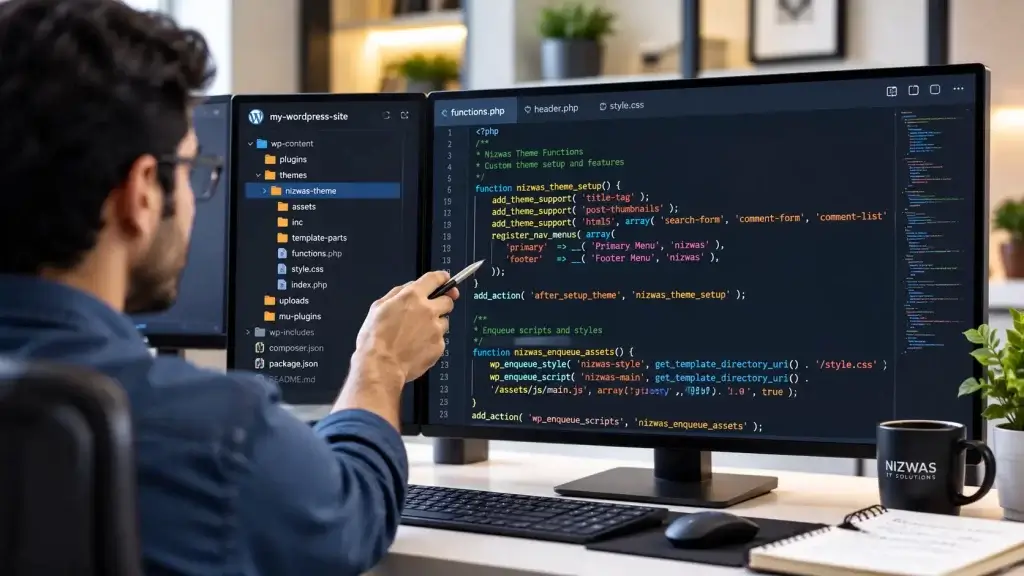
Building a feature from scratch, repairing a broken website, or working around legacy code can require more investigation than configuring an established solution.
Other factors include content migration, accessibility requirements, multilingual support, third-party licence fees, security needs, deadlines, and the level of post-launch support.
Freelance WordPress Developer vs. Agency vs. Full-Time Employee
The right hiring model depends on how much work you have and how much responsibility you want the developer to take on.
| Hiring option | Best suited to | Main consideration |
|---|---|---|
| Freelancer | Defined projects and flexible workloads | Confirm availability, backup support, and deliverables |
| Development agency | Projects needing several disciplines | Check who will do the work and what is included |
| Full-time employee | Continuous internal development needs | Include salary, benefits, equipment, management, and recruitment |
| Remote development partner | Ongoing work without a local hire | Establish communication, security, time-zone overlap, and accountability |
A full-time employee’s wage is not directly comparable with a freelancer’s hourly rate. An employee’s total cost can include employer taxes, benefits, paid leave, equipment, recruitment, and management overhead. A freelancer’s rate usually needs to cover their own business expenses and periods without billable work.
For an initial project, a freelancer or agency may be more practical than hiring an employee. For a business with a sustained development backlog and daily internal requirements, an employee may be worth evaluating.
Should a Texas business hire locally or remotely?
A local developer can offer convenient in-person meetings and familiarity with the local business environment. A remote developer may offer a better fit in terms of specialist skills, availability, or budget.
Location should not replace technical evaluation. Ask every candidate to explain their approach, demonstrate relevant work, describe how they test changes, and identify what happens if a deadline or production issue arises.
For businesses considering a remote development partner, Nizwas provides WordPress website design and development services covering business websites, WooCommerce, landing pages, redesigns, and ongoing technical considerations.
Step-by-Step Guide to Hiring a WordPress Developer in Texas
Step 1: Write a clear project brief
Before contacting developers, document the essentials:
- What business problem should the website solve?
- How many pages and templates are needed?
- Do you need eCommerce, booking, memberships, or CRM integrations?
- Will you provide copy, images, branding, and product data?
- Do you have an existing website that must be migrated?
- What is the target launch date?
- Who will approve the design and functionality?
A clear brief helps developers estimate the work on a comparable basis.
Step 2: Set a realistic budget
Establish a budget range before requesting proposals. Keep the development budget separate from recurring hosting, premium plugins, stock assets, copywriting, marketing, and future maintenance.
It is also sensible to retain a contingency for requirements that emerge during discovery. The appropriate reserve depends on how well the scope is defined; there is no single percentage that fits every project.
Step 3: Review relevant experience
Ask for examples of websites with similar requirements. A developer who has built brochure websites may not have the experience needed for a complex WooCommerce store or custom membership platform.
Look for evidence of:
- Relevant functionality and integrations.
- Responsive design and usability.
- Maintainable WordPress implementation.
- Performance testing and security practices.
- Successful migration or launch experience, if applicable.
Do not rely on screenshots alone. Where possible, inspect live websites and ask what work the developer personally completed.
Step 4: Request itemized proposals
Ask each candidate to break the quotation into major work areas. The goal is to understand the difference between a lower price and a genuinely smaller scope.
A useful proposal identifies deliverables, milestones, assumptions, exclusions, payment terms, revision limits, and support after launch.
Step 5: Agree on ownership and access
Your business should have clear arrangements for domain registration, hosting, WordPress administrator access, source code, backups, and relevant licence accounts.
Use individual accounts and appropriate permissions rather than sharing one administrator password among several people. Confirm which custom code and deliverables will be transferred when the project is complete.
Step 6: Test before launch
Before approving the final payment, verify:
- Mobile and desktop layouts.
- Contact forms, email notifications, and checkout flows.
- Navigation, redirects, and important links.
- Backup and restoration arrangements.
- Basic SEO configuration and indexing directives.
- Performance and security essentials.
- Administrator access and handover documentation.
The acceptance criteria should be agreed upon before the project starts, not introduced at the final review.
Common Mistakes to Avoid
Choosing solely on hourly rate
A low hourly rate does not guarantee a low total cost. Compare estimated effort, technical fit, scope, and the likelihood of rework.
Failing to distinguish design from development
A visually attractive mockup does not automatically include responsive implementation, forms, integrations, content entry, testing, or launch.
Assuming SEO is included
Some developers include basic metadata and sitemap configuration; others quote SEO separately. Clarify whether keyword research, content writing, technical audits, redirects, schema, and Search Console setup are included.
Ignoring maintenance and licensing
Ask which premium themes, plugins, hosting plans, and external services require renewals. Confirm who is responsible for updates, backups, monitoring, and emergency fixes.
Approving vague change requests
Define how additional work will be priced and approved. Written change requests help prevent misunderstandings about budget and deadlines.
Paying without clear milestones
Agree on deliverables and payment dates. Keep access, ownership, and handover requirements documented throughout the project.
Expert Tips and Best Practices
Invest in the requirements before the design
A discovery phase can identify unnecessary features and clarify which functions matter most to customers. This is particularly valuable when multiple stakeholders have different expectations.
Use established tools when they meet the requirements
WordPress and established plugins can reduce development effort, but adding too many plugins can increase complexity. Choose tools based on functionality, maintenance, compatibility, and security—not simply on popularity.
Plan for growth without overbuilding
A small business may not need a custom application on day one. A well-structured WordPress site can provide a sensible starting point while allowing new integrations or functionality when there is a demonstrated need.
Include performance and security in acceptance criteria
Ask the developer how they will test page performance, handle backups, manage updates, and protect administrative access. Avoid accepting vague promises such as “perfect speed” or “100% secure”; measurable checks and documented processes are more useful.
Separate launch work from ongoing marketing
Development can establish the technical foundation, but traffic and leads also depend on content quality, demand, competition, user experience, and marketing execution.
For businesses whose websites need a technical review, Nizwas offers technical SEO services. A technical audit can identify implementation issues, but it cannot guarantee rankings or conversions.
Frequently Asked Questions
For initial planning, a straightforward business website might require $1,500–$4,000, while a custom business website may require $3,000–$8,000. Complex eCommerce and custom applications can cost considerably more. These are illustrative estimates; request a written quote based on your requirements.
Upwork’s Texas-specific directory currently lists typical rates of around $25–$45 per hour. Individual rates vary with experience, specialization, project complexity, and the hiring arrangement. This marketplace range should not be treated as a definitive statewide average.
A freelancer can be cost-effective for a well-defined project. An agency may be more suitable when the project needs coordinated design, development, content, and quality assurance. Compare the complete scope and total cost rather than assuming one option is always cheaper.
A simple website may take a few weeks, while a larger custom website or eCommerce platform can take several months. The timeline depends on functionality, content readiness, feedback cycles, integrations, and testing.
Not necessarily. Hosting, domain registration, premium plugin licences, ongoing maintenance, and marketing are often separate costs. Ask for a clear breakdown of one-time and recurring expenses.
Yes. Remote hiring gives businesses access to developers outside their immediate area. Confirm communication arrangements, relevant experience, security practices, time-zone overlap, source-code ownership, and support availability before signing an agreement.
Prepare a detailed brief, agree on deliverables and revision limits, identify paid licences and third-party integrations, and require approval for additional work. Include testing, launch, and handover requirements in the original agreement.
WordPress can be a practical option for business websites, service businesses, blogs, and many eCommerce projects because it supports flexible content management and extensive customization. Its suitability depends on the required functionality, security needs, maintenance capacity, and long-term goals.
Final Thoughts
The WordPress developer cost in Texas in 2026 depends less on the number of pages alone and more on the work required to deliver a reliable, maintainable website.
A small service business may need a straightforward WordPress build. A growing retailer may need WooCommerce, payment integrations, inventory workflows, and ongoing technical support. Those projects should not be evaluated using the same budget assumptions.
Before hiring, define your requirements, compare itemized proposals, check relevant experience, and confirm ownership, testing, and maintenance arrangements.
The goal is not simply to find the lowest-priced developer. It is to invest in a website that fits your business today and can be maintained as your requirements change.
If you are planning a new website, redesign, WooCommerce project, or WordPress improvement, contact Nizwas IT Solutions to discuss your requirements and request a project-specific estimate.