A business can rank #1 on Google and still get very few customers.
That sounds strange until you look at what kind of searches the business is ranking for.
A local plumber ranking for a broad national search such as “plumbing tips” may receive thousands of visitors who will never become customers.
Meanwhile, ranking prominently for:
“emergency plumber near me”
could bring a much smaller number of searches — but from people who actually need the service.
The opposite can happen with an online software company.
If its customers can purchase from anywhere in the country, focusing heavily on city-based searches may limit its growth.
This is why the question isn’t really:
“Is local SEO better than national SEO?”
The better question is:
“Where are my customers, and how do they search before buying?”
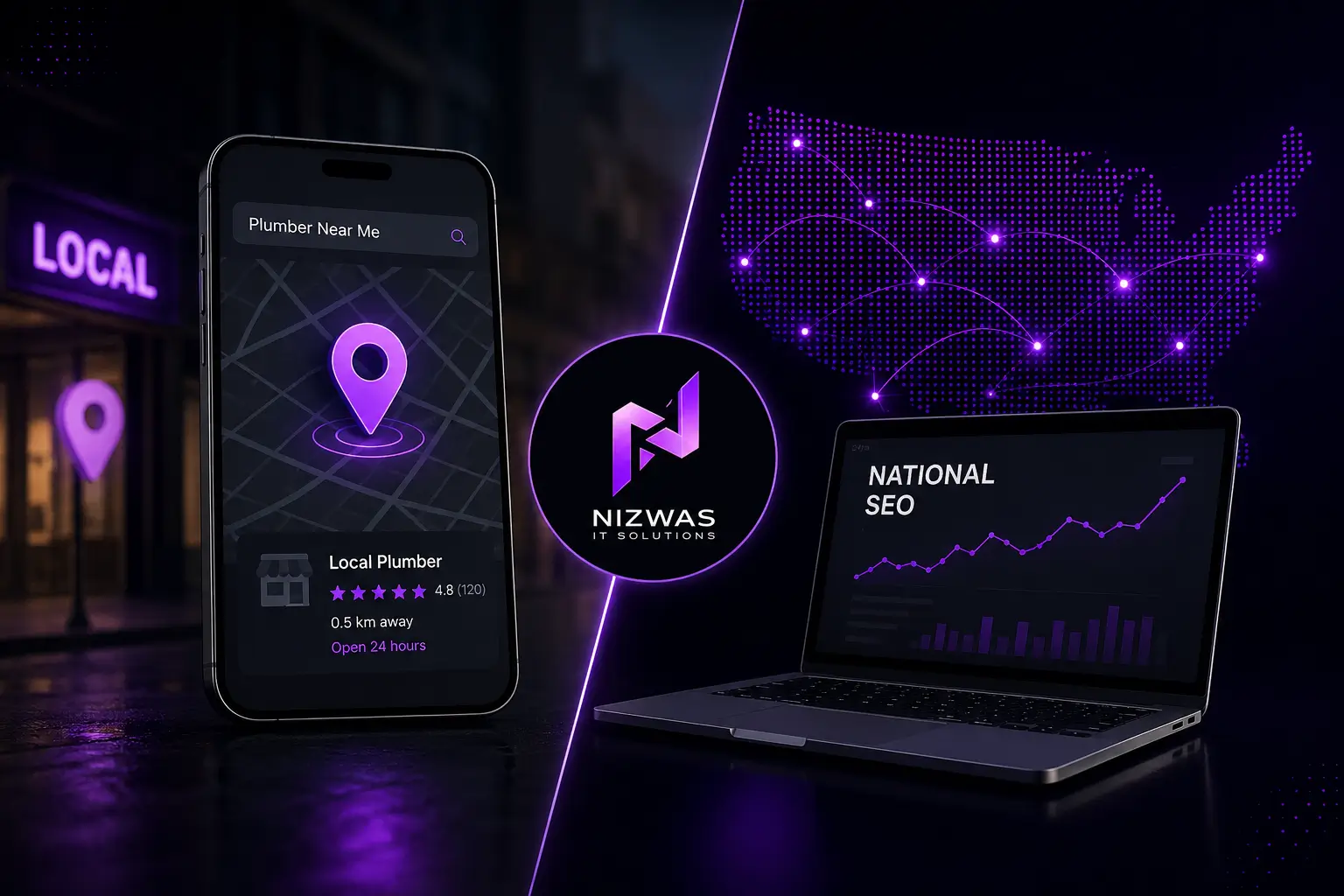
Local SEO is built around geographic intent. National SEO focuses on broader searches where physical proximity is less important. Current 2026 comparisons consistently identify Google Business Profile, proximity and local relevance as central to local SEO, while national SEO relies more heavily on website content, topical authority and broader organic visibility.
And for some businesses, the correct answer isn’t either/or.
You need both.
Part 1: What Is Local SEO?
Local SEO is the process of improving a business’s visibility when people search for products or services within a particular geographic area.
The searches might include a location:
SEO company in Delhi
dentist in Manchester
plumber in Toronto
Or they might imply location:
dentist near me
restaurants near me
emergency electrician
Google can use the searcher’s location and other signals to determine which local businesses are relevant.
Google itself explains that local results are primarily influenced by relevance, distance and prominence.
That makes local SEO fundamentally different from simply trying to rank a website for a broad keyword.
Local SEO has two major search opportunities
Google Maps and local results
For many local searches, Google displays businesses through Google Maps and Business Profiles.
A customer may see:
- Business name
- Reviews
- Location
- Opening hours
- Phone number
- Website
- Photos
- Services
- Directions
before visiting your website.
This is why Google Business Profile optimization is such an important part of local SEO.
Google recommends that businesses verify their profile and keep business information complete and accurate. It also states that there is no way to pay for a better local ranking.
Local organic results
Local SEO also involves the traditional organic results underneath or around the map results.
For example:
Best WordPress developers in Delhi
might produce local businesses, service pages, directories, articles and other relevant websites.
Your website therefore still matters.
Local SEO isn’t simply:
“Create a Google Business Profile.”
It is a combination of your business profile, website, reputation, relevance, links, content and overall online presence.
Who needs local SEO?
Local SEO is usually the better starting point when customers need to interact with a business in a particular geographic area.
Examples include:
- Dentists
- Doctors and clinics
- Plumbers
- Electricians
- Roofers
- Restaurants
- Hotels
- Salons
- Gyms
- Lawyers
- Real estate agencies
- Local retailers
- Auto repair shops
- Cleaning companies
- Photographers
- Local marketing agencies
- Construction companies
Service-area businesses can also benefit even if customers don’t visit a physical storefront.
For example, a plumber may travel to customers rather than operate a traditional shop.
Part 2: What Is National SEO?
National SEO focuses on reaching customers across a much broader geographic market, usually an entire country.
Instead of:
web design company in Delhi
you might target:
web design company
Instead of:
accounting software in Mumbai
you might target:
accounting software
The search doesn’t depend primarily on physical proximity.
A customer in Delhi, Mumbai, Bengaluru or Kolkata may all be potential customers.
Who benefits from national SEO?
National SEO can make sense for:
E-commerce businesses
If you ship products throughout the country, your customers aren’t limited to one city.
SaaS companies
A software product can often be purchased from anywhere.
Online education
Courses and training programs can reach customers nationally.
Digital products
Templates, plugins, software and digital downloads aren’t dependent on a physical location.
National service providers
Some consulting, legal, financial, technology or B2B businesses serve clients across multiple states or regions.
Large brands
Businesses with multiple offices or a nationwide customer base may need national visibility alongside local campaigns.
National SEO is usually a broader authority game
The further you expand geographically, the larger your competitive field becomes.
A local business may compete against dozens or hundreds of relevant companies within a city.
A national website may compete with:
- Major brands
- Industry publishers
- Large directories
- Established websites
- Specialized publications
- National competitors
That changes the SEO strategy.
National campaigns often require greater emphasis on:
- Content depth
- Topic clusters
- Strong service/product pages
- Internal linking
- Digital PR
- High-quality backlinks
- Brand authority
- Technical SEO
- Search intent
- Comprehensive keyword research
Current industry comparisons similarly identify broader authority, content depth and backlinks as more important components of national SEO, while local SEO puts more emphasis on geographic relevance, Google Business Profile and reviews.
Part 3: Local SEO vs National SEO, The Real Difference
The easiest way to understand the difference is to stop thinking about geography alone.
Think about customer intent.
| Factor | Local SEO | National SEO |
|---|---|---|
| Primary audience | Customers in a defined area | Customers across a country |
| Main geographic focus | City, region, neighborhood | Country or broad market |
| Google Business Profile | Very important | Usually not central |
| Google Maps visibility | Important | Usually irrelevant |
| Local reviews | Highly valuable | Less central |
| Proximity | Important for local results | Generally not the main consideration |
| Keywords | Location + service | Broad service/topic keywords |
| Content | Local + service focused | Topic + industry focused |
| Link building | Local and industry relevance | Broader authority |
| Competition | Geographic competitors | National competitors |
| Main conversion | Calls, visits, bookings, leads | Leads, sales, signups |
| Best for | Local/service-area businesses | E-commerce, SaaS, national brands |
| Main measurement | Local visibility + leads | Organic visibility + conversions |
The distinction becomes particularly clear when you compare two searches.
Search 1:
“Dentist near me”
Google needs to determine:
Which businesses are relevant and close to this person?
Search 2:
“Best dental insurance”
The searcher isn’t necessarily looking for a dentist nearby.
Google needs to determine:
Which pages provide the most useful answer to this topic?
Those are different search problems.
And they require different SEO strategies.
Local SEO competes for a place
This is one of the simplest ways to remember the difference.
Local SEO asks:
Which business should appear for this customer in this area?
Google’s local ranking documentation explicitly identifies relevance, distance and prominence as key factors.
That means a business can be excellent nationally but still struggle to appear prominently in a particular city if it doesn’t have strong local relevance.
National SEO competes for a subject
National SEO asks:
Which website or page is the strongest answer to this search?
That requires building topical relevance and authority.
A company might publish:
- Comprehensive guides
- Comparisons
- Research
- Case studies
- Product pages
- Tutorials
- Industry resources
over time.
This creates a broader topical footprint.
Part 4: Which SEO Strategy Should Your Business Choose?
This is where the decision becomes practical.
Don’t choose local or national SEO because one sounds more impressive.
Choose based on your business model.
Choose local SEO if customers need you nearby
Ask yourself:
Does the customer care where my business is located?
If the answer is yes, local SEO should probably be a major part of your strategy.
For example, if you’re a dentist in Delhi, someone searching from Delhi has a completely different need from someone searching in Mumbai.
Your physical presence matters.
The same applies to:
- Plumbers
- Electricians
- Restaurants
- Clinics
- Salons
- Local contractors
- Lawyers
- Real estate agents
Choose national SEO if geography doesn’t matter
Ask:
Could I serve this customer regardless of which city they live in?
If yes, national SEO may be the better fit.
Examples:
SaaS
A customer can subscribe from anywhere.
E-commerce
A store may ship nationwide.
Online courses
Students don’t need to live nearby.
WordPress plugins
The customer could be anywhere in the world.
Remote consulting
A business may serve clients entirely online.
What about a digital agency?
This is where things become interesting.
A digital agency may serve both local and national clients.
For example:
Web design company in Delhi
has local intent.
But:
could have national or even international intent.
The agency doesn’t necessarily have to choose one.
It can create two complementary strategies.
Local layer
Target:
- City-based services
- Google Business Profile
- Local reviews
- Local citations
- Local landing pages
- Local partnerships
National layer
Target:
- Broad service keywords
- Technical guides
- Industry content
- Case studies
- National backlinks
- Topic clusters
This approach can be particularly powerful because the two strategies support the same business.
Don’t create dozens of city pages just to rank locally
This is one of the biggest mistakes businesses make.
Imagine an agency creates:
SEO Agency Delhi
SEO Agency Mumbai
SEO Agency Bangalore
SEO Agency Chennai
SEO Agency Pune
SEO Agency Hyderabad
But every page contains almost exactly the same content.
Changing the city name isn’t enough.
A useful local page should provide genuine information about that location and the business’s actual ability to serve customers there.
Google’s current people-first guidance emphasizes original, substantial and useful content rather than producing pages primarily to capture search traffic.
If you genuinely operate in several cities, build meaningful location pages.
If you don’t, don’t manufacture locations simply for SEO.
Part 5: How to Build the Right Strategy — and Measure It
Once you’ve decided whether your business needs local, national or both, the next step is creating a strategy around the decision.
Step 1: Define your actual customer
Before keyword research, answer:
Who buys from us?
Then:
Where are they located?
Then:
What do they search before contacting us?
This prevents a common SEO mistake:
Choosing keywords first and customers second.
Your customer should determine the keyword strategy.
Local keyword research
Local keyword research usually includes combinations of:
Service + location
SEO agency Delhi
Service + area
plumber Noida
Service + neighborhood
dentist South Delhi
Implicit local intent
emergency plumber near me
But don’t create content for every possible combination.
Focus on commercially meaningful searches.
Current keyword data shows strong demand around broad local SEO terms: “local SEO” is reported at about 22,200 monthly US searches, “local SEO optimization” around 14,800, and “local SEO for business” around 3,600.
These figures demonstrate the broader demand for local search optimization, but your actual service keywords should be researched for the specific country and market you want to target.
National keyword research
National SEO research focuses more heavily on:
- Search intent
- Topic clusters
- Commercial keywords
- Informational keywords
- Comparison queries
- Product/service searches
- Long-tail opportunities
For example, a national WordPress company could target:
Then create supporting content:
How to secure WordPress
WooCommerce optimization guide
WordPress maintenance checklist
This creates topical depth rather than relying on one keyword.
Google’s SEO guidance encourages unique, useful, well-organized content and specifically says creators should think about the terms users may search while avoiding the need to anticipate every exact keyword variation.
Build local authority
For local businesses, focus on becoming recognizable in the market you serve.
That can include:
- Google Business Profile
- Genuine customer reviews
- Local citations
- Local directories
- Industry associations
- Local partnerships
- Community involvement
- Local publications
- Location-specific content
- Local backlinks
Google says prominence can include signals such as links from other websites and reviews.
But don’t turn this into a directory-submission race.
A hundred irrelevant citations aren’t necessarily more valuable than a few trustworthy local references.
Build national authority
National SEO requires a broader authority strategy.
Focus on:
Excellent content
Create resources worth referencing.
Digital PR
Get your expertise mentioned in relevant publications.
Original research
Publish data, studies, surveys or useful analysis.
Strong backlinks
Earn links from relevant and authoritative websites.
Topic clusters
Build comprehensive coverage around important subjects.
Strong internal linking
Connect related pages so users and search engines can navigate the site’s expertise.
How to measure local SEO
Don’t judge local SEO entirely by organic traffic.
A local business may receive fewer visits but significantly more leads.
Track:
- Google Business Profile visibility
- Local rankings
- Map visibility
- Phone calls
- Direction requests
- Website visits
- Form submissions
- Bookings
- Qualified leads
- Revenue
Google’s Business Profile ecosystem provides business performance information, while Google states that local ranking is influenced by relevance, distance and prominence.
The most important question is:
Are more qualified local customers contacting the business?
How to measure national SEO
National campaigns need a broader measurement system.
Track:
- Organic traffic
- Non-brand clicks
- Keyword visibility
- Search impressions
- Conversion rate
- Leads
- Revenue
- Top-performing pages
- Backlinks
- Brand searches
- Assisted conversions
Traffic alone isn’t enough.
A page bringing 10,000 visitors but generating no customers may be less valuable than a page bringing 500 highly relevant visitors and producing 20 leads.
What if you need both?
Many growing companies do.
A useful structure might look like:
Homepage│├── Local Services│ ├── SEO Services – Delhi│ ├── Web Development – Delhi│ └── Local SEO – Delhi│├── National Services│ ├── SEO Services│ ├── WordPress Development│ └── Technical SEO│└── Resources ├── SEO Guides ├── Case Studies ├── Technical Tutorials └── Industry Research
The important thing is to keep the intent clear.
Don’t make every page compete with every other page.
Local SEO vs National SEO: Quick Decision Test
Use these questions.
Question 1
Do customers physically visit you or do you travel to them?
Yes → Local SEO
Question 2
Can customers buy from you anywhere in the country?
Yes → National SEO
Question 3
Does distance influence whether someone chooses you?
Yes → Local SEO
Question 4
Can the service be delivered completely online?
Yes → National SEO may be more important
Question 5
Do you have branches in multiple cities?
Yes → Local + National
Question 6
Do you have both local and online products/services?
Yes → Local + National
Common Mistakes Businesses Make
Trying to rank nationally when the customer is local
A local business can waste months competing for broad keywords when its customers are searching by location.
Focusing only on Google Business Profile
Local SEO isn’t only Maps.
Your website still matters.
Creating hundreds of location pages
Location pages without genuine value can create a weak website rather than a stronger one.
Measuring traffic instead of revenue
More traffic isn’t necessarily more business.
Targeting keywords with no buying intent
A keyword can have impressive search volume and still generate poor leads.
Copying national SEO strategies for local businesses
A local plumber doesn’t need the same content architecture as a nationwide SaaS company.
Copying local SEO strategies for national companies
A national e-commerce company can’t build its entire strategy around one Google Business Profile.
Final Verdict: Local SEO or National SEO?
There isn’t one universal winner.
Local SEO wins when geography affects the buying decision.
National SEO wins when customers can buy from you regardless of where they live.
And if your business operates both locally and nationally, combining the two can be the smartest approach.
The key is not to divide your SEO budget 50/50 automatically.
Instead, ask:
Where does the highest-value demand come from?
If most customers are nearby, invest heavily in local visibility.
If customers come from across the country, build national authority.
If you have both, create separate but connected strategies.
Google’s own documentation makes the local distinction particularly clear: local rankings are primarily influenced by relevance, distance and prominence, while its broader SEO guidance emphasizes useful, reliable, people-first content and helping search engines understand your website.
That’s the real difference.
Local SEO helps you become the right business in the right place.
National SEO helps you become the right resource for a broader market.
The best strategy is the one that matches how your customers actually buy.
Frequently Asked Questions
1. What is the difference between local SEO and national SEO?
Local SEO focuses on customers in a specific geographic area, while national SEO targets customers across a broader country or market. Local SEO places greater emphasis on geographic relevance, Google Business Profile, proximity and reviews, while national SEO relies more on content, authority, backlinks and broader organic visibility.
2. Is local SEO better than national SEO?
Neither is universally better. Local SEO is usually more appropriate when customers need a nearby business or service. National SEO is more appropriate when a company can serve customers throughout a country without geographic limitations.
3. Who needs local SEO?
Businesses such as restaurants, dentists, plumbers, electricians, lawyers, contractors, salons, clinics, local retailers and service-area businesses can benefit strongly from local SEO.
4. Who needs national SEO?
National SEO is often appropriate for e-commerce companies, SaaS businesses, online education, digital products, nationwide service providers and companies serving customers across an entire country.
5. Can a business use both local and national SEO?
Yes. Businesses with both local customers and nationwide products or services can run complementary local and national SEO strategies.
6. Does Google Business Profile matter for local SEO?
Yes. Google Business Profile is a central component of local SEO because it helps businesses manage their presence on Google Search and Maps. Google recommends keeping business information complete and accurate and identifies relevance, distance and prominence as major local ranking considerations.
7. Is national SEO more difficult than local SEO?
It can be, particularly for competitive industries. National campaigns often compete against established brands and authoritative websites across an entire country, while local campaigns have a more geographically defined competitive field. However, difficulty varies significantly by industry and keyword.
8. Does local SEO require a physical store?
Not necessarily. Eligible service-area businesses can also benefit from local SEO when they travel to customers instead of operating a traditional storefront.
9. Does national SEO require backlinks?
Backlinks are one part of a broader national SEO strategy. Strong content, technical SEO, topical relevance, internal linking, brand authority and other factors also matter.
10. How long does local SEO take to work?
There is no guaranteed timeframe. Results depend on competition, location, existing authority, website quality, Google Business Profile strength, reviews and the starting condition of the business.
11. How long does national SEO take?
National SEO can take longer in competitive markets because the website may need to build substantial topical and domain authority. There is no universal timeline.
12. Should a local business target national keywords?
It can, but only when those keywords support the business’s actual goals. A local business should usually prioritize searches that can realistically produce customers in its service area before pursuing extremely broad national terms.
13. Should I create a page for every city I serve?
Only when those locations represent genuine service markets and each page can provide useful, distinct information. Creating large numbers of near-identical city pages solely to capture search traffic is unlikely to be a strong long-term strategy. Google’s guidance emphasizes original, substantial, people-first content.
14. What keywords are best for local SEO?
The best local keywords combine relevant services with genuine geographic or local intent, such as service-and-city searches, neighborhood searches and appropriate “near me” queries.
15. What keywords are best for national SEO?
National keywords depend on the business and search intent. They can include broad commercial terms, product/service keywords, informational topics, comparison searches and long-tail queries that match the national audience.
16. How do I know which SEO strategy is right for my business?
Start with three questions: Where are your customers located? Does proximity influence their buying decision? Can you deliver your product or service anywhere in the country? Your answers will usually indicate whether local SEO, national SEO or a combination is appropriate.