Introduction
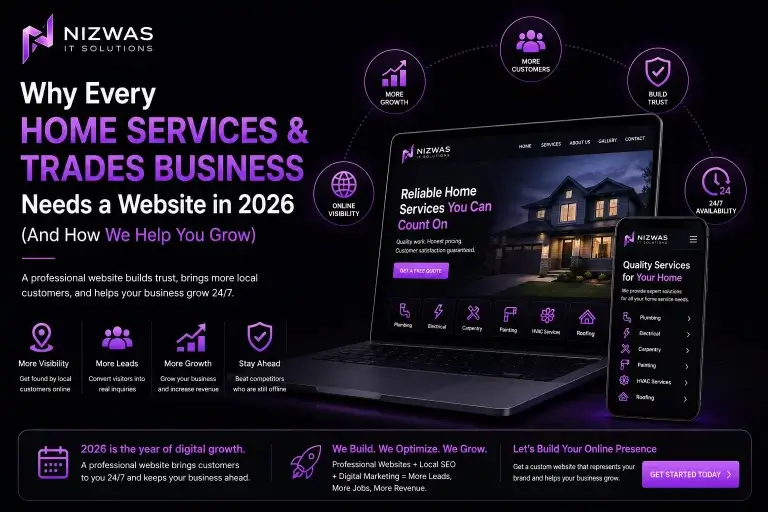
If you run a plumbing company, an electrical contracting business, an HVAC service, a roofing crew, or any other trade business, you already know your reputation is everything. Word of mouth used to be enough. A satisfied customer told their neighbor, who told their cousin, and the phone kept ringing.
But that world has changed. Today, before a homeowner ever picks up the phone to call a plumber or electrician, they do one thing first: they search online. Whether they’re in Los Angeles, Toronto, or Bengaluru, the behavior is the same, open Google, type “plumber near me” or “AC repair services,” and choose from whoever shows up first.
If your business doesn’t have a website, or has one that’s outdated, slow, or invisible on Google — you’re not just missing a “nice-to-have.” You’re losing paying customers to competitors who show up first, look more professional, and make it easier to book a job.
This guide explains exactly why home services and trades businesses need a strong online presence, and how the right website, built and optimized correctly can become the single most powerful growth tool in your business.
The Home Services Industry Has Moved Online
Across the USA, Canada, and India, homeowners increasingly rely on search engines, online reviews, and mobile browsing to find and vet local service providers before making a call. This shift applies across every trade — plumbing, electrical, HVAC, roofing, pest control, landscaping, painting, and general contracting.
A few realities driving this shift:
- Mobile search dominates. Most local searches for services like “emergency plumber” or “AC repair near me” happen on a smartphone, often when something has already gone wrong and the customer needs help fast.
- Reviews influence decisions. Homeowners routinely compare star ratings and read reviews before choosing between two or three providers.
- Trust is built visually. A clean, professional website signals legitimacy the same way a branded truck or uniformed technician does in person.
- Convenience wins the job. Businesses that make it easy to request a quote, check availability, or book online capture customers that slower competitors lose.
If your business isn’t visible in that first search, you’re invisible to a growing share of your potential customers — no matter how good your actual work is.
Why a Website Matters More Than Ever for Trades Businesses
1. It’s Often Your First Impression
Before a customer ever meets you in person, your website is the first thing that shapes their opinion of your business. A professional, well-designed site builds instant credibility. An outdated or missing one raises doubt — even if your work is excellent.
2. It Builds Trust Before the Phone Call
Customers want to see proof: photos of completed jobs, licensing and insurance information, service areas, and genuine reviews. A website lets you present all of this upfront, so by the time someone calls, they’re already halfway convinced to hire you.
3. It Works for You 24/7
Unlike a phone line that goes unanswered after hours, a website keeps working around the clock — answering questions, showcasing services, and capturing leads even while you’re on a job site or asleep.
4. It Helps You Outrank Competitors
Search engines reward businesses with strong, well-optimized websites by ranking them higher for local searches. Without one, you’re relying entirely on paid ads, directory listings, or luck to get found — all far less sustainable than owning your own search visibility.
5. It Supports Every Other Marketing Channel
Your website becomes the hub that everything else points back to — Google Business Profile, social media, online reviews, referral links, and paid ads all drive traffic toward one place where customers can actually convert into booked jobs.
6. It Increases Perceived Value
A polished website allows trades businesses to justify premium pricing. Customers are often willing to pay more for a company that looks established, professional, and reliable — rather than choosing the cheapest option out of uncertainty.
What a High-Converting Home Services Website Actually Needs
Not every website drives results. Many trades businesses have a site that exists but doesn’t actually generate calls or bookings. Here’s what separates a website that works from one that just sits there:
- Clear, mobile-friendly design — since most local searches happen on phones, your site needs to load fast and look great on small screens.
- Prominent calls-to-action — “Call Now,” “Get a Free Quote,” or “Book Online” buttons should be visible on every page, not buried in a menu.
- Service area pages — dedicated pages for each city or region you serve help you rank in more local searches simultaneously.
- Before-and-after photos — visual proof of completed work builds instant trust with potential customers.
- Genuine customer reviews and testimonials — displayed prominently, ideally pulled directly from Google or other verified platforms.
- Licensing, insurance, and certification details — especially important for trades where trust and safety matter.
- Fast-loading, secure pages — slow websites lose visitors within seconds, and security (HTTPS) is now a baseline expectation.
- Local SEO optimization — proper metadata, structured data, and keyword targeting so your business actually appears when people search.
- FAQ sections with schema markup — helping you appear in rich search results and voice search answers, which we’ll cover in detail below.
How We Help Home Services & Trades Businesses Grow Online
We specialize in building websites specifically for plumbing, electrical, HVAC, roofing, landscaping, and other home services businesses across the USA, Canada, and India. Here’s how we help you turn your website into a genuine growth engine rather than just a digital business card:
1. Custom Website Design Built for Conversions
We design websites specifically around how homeowners search for and choose trades businesses — clear service listings, prominent contact options, and layouts proven to turn visitors into booked jobs.
2. Local SEO Optimization
We optimize your site’s metadata, page structure, and content so you rank higher for the searches that matter most in your specific service area — whether that’s a single city or an entire metro region.
3. Google Business Profile Management
Your website works hand-in-hand with your Google Business listing. We help ensure both are aligned, accurate, and optimized to maximize your visibility in local map results.
4. Mobile-First, Fast-Loading Pages
Every site we build is optimized for speed and mobile performance, ensuring you don’t lose potential customers to a slow-loading page.
5. FAQ Content and Schema Markup
We build out FAQ sections addressing the real questions your customers are searching for, then implement structured schema markup so those answers can appear directly in Google search results — increasing your visibility without requiring a higher ranking position.
6. Ongoing Content and Reputation Support
Beyond the initial build, we help you maintain fresh content, gather and showcase reviews, and keep your site performing well as search engine algorithms evolve.
Understanding Meta Data — and Why It Matters for Your Business
“Meta data” refers to the behind-the-scenes information that tells search engines what your website and each individual page is about. While customers never see this code directly, it plays a massive role in whether your business shows up in search results at all.
Key elements include:
- Meta titles — the clickable headline shown in search results; these should include your trade, service, and location (e.g., “Emergency Plumbing Services in Toronto | 24/7 Licensed Plumbers”).
- Meta descriptions — the short summary beneath the title that encourages users to click; a compelling, keyword-rich description improves click-through rates.
- Header tags (H1, H2, H3) — used to structure content logically, helping both users and search engines understand your page.
- Alt text for images — descriptions attached to photos (like completed jobs) that help search engines understand visual content and improve accessibility.
- Schema markup — structured data that helps search engines display rich results, such as star ratings, FAQs, service areas, and business hours directly in search listings.
When these elements are set up correctly across every page of your website, your business becomes significantly easier for search engines to understand — and easier for customers to find.
Why FAQ Sections and FAQ Schema Are a Game-Changer
Adding a well-written FAQ section to your website does more than answer customer questions — it directly improves your visibility in search results.
Here’s why FAQ content matters:
- It targets the exact questions customers are typing into Google before hiring a trades business.
- It builds trust by proactively answering common concerns about pricing, availability, and service areas.
- It keeps visitors on your site longer, which signals relevance to search engines.
Here’s why FAQ schema takes it further: FAQ schema is a piece of structured code added to your website that tells Google exactly which content is a question and which is an answer. When implemented correctly, Google can display your FAQs directly within search results as an expandable dropdown — giving your listing significantly more space on the results page, even if you’re not the very first result.
This means more visibility, more clicks, and more trust — all without needing to outrank every competitor for the top spot.
Example FAQ Schema Markup (JSON-LD)
Below is a simplified example of how FAQ schema is structured for a home services business:
{
  "@context": "https://schema.org",
  "@type": "FAQPage",
  "mainEntity": [
    {
      "@type": "Question",
      "name": "Do you offer emergency plumbing services?",
      "acceptedAnswer": {
        "@type": "Answer",
        "text": "Yes, we offer 24/7 emergency plumbing services for urgent issues like burst pipes, major leaks, and sewer backups."
      }
    },
    {
      "@type": "Question",
      "name": "What areas do you serve?",
      "acceptedAnswer": {
        "@type": "Answer",
        "text": "We proudly serve homeowners and businesses across [Your City/Region], along with several surrounding communities."
      }
    }
  ]
}
We handle this technical implementation for every website we build, ensuring your FAQ content is fully eligible for rich results in search.
Common Website Mistakes That Cost Trades Businesses Customers
Even businesses that have a website often lose potential customers due to avoidable mistakes. Watch out for these common pitfalls:
- No clear phone number or CTA above the fold. If a visitor has to scroll or search to find your contact information, many will simply leave and call a competitor instead.
- Slow loading times. Studies consistently show that users abandon a page if it takes more than a few seconds to load — especially on mobile, where most home services searches happen.
- Outdated design. A site that looks like it was built a decade ago signals to customers that your business practices might be outdated too, even if that’s far from true.
- No reviews or social proof. Without visible testimonials or star ratings, new visitors have no way to quickly validate that you’re trustworthy.
- Missing service area information. If customers can’t quickly confirm you serve their neighborhood or city, they’ll move on to a competitor who makes that clear immediately.
- No local SEO strategy. A beautiful website that nobody can find in search results won’t generate the leads your business needs to grow.
- Ignoring mobile users. Desktop-only designs that don’t adapt properly to phones create a frustrating experience for the majority of your visitors.
Avoiding these mistakes — or fixing them if they already exist on your current site — can immediately improve how many visitors convert into actual paying customers.
The Real Return on Investment of a Professional Website
Many trades business owners hesitate to invest in a professional website, viewing it as an expense rather than a growth tool. In reality, a well-built, properly optimized website consistently delivers strong returns:
- Lower cost per lead over time. Unlike paid ads that stop generating leads the moment you stop paying, organic search visibility from a well-optimized website continues generating inquiries long-term.
- Higher-quality leads. Customers who find you through search and review your website before calling tend to be better informed and more likely to book, compared to cold outreach or generic directory listings.
- Increased average job value. A professional online presence supports premium pricing, as customers associate a polished website with higher-quality, more reliable service.
- Compounding growth. Every review, completed project, and blog post you add strengthens your site’s authority, making it easier to rank for new searches over time rather than starting from scratch each month.
Viewed this way, a website isn’t a one-time cost — it’s an ongoing asset that keeps generating value for your business long after it’s built.
Frequently Asked Questions
Why does my trades business need a website if I already get referrals? Referrals are valuable, but relying on them alone limits your growth. A website allows new customers who don’t know you yet — the majority of the market — to find, trust, and hire you.
How long does it take to see results from a new website? Basic visibility improvements can appear within a few weeks, but meaningful local SEO rankings typically build over two to six months, depending on competition in your area.
Do I need a separate website for each city I serve? Not necessarily a separate website, but dedicated service-area pages within one website are highly effective for ranking in multiple locations.
Will a website really help me get more calls and bookings? Yes — a well-optimized, mobile-friendly website with clear calls-to-action consistently converts visitors into leads, especially when paired with strong local SEO and Google Business Profile optimization.
Do you work with home services businesses outside the USA? Yes, we work with plumbing, electrical, HVAC, and other trades businesses across the USA, Canada, and India, tailoring strategies to each region’s search behavior and market.
What makes your approach different from a generic website builder? We build specifically for the home services and trades industry, meaning every design decision, page structure, and SEO strategy is based on how homeowners actually search for and choose service providers — not a one-size-fits-all template.
Final Thoughts
The home services and trades industry has fully shifted online, and homeowners across the USA, Canada, and India are searching for providers like you every single day. The businesses that win aren’t necessarily the ones doing the best work — they’re the ones that are the easiest to find, the most trustworthy at first glance, and the simplest to book.
A professional, SEO-optimized website complete with strong metadata, a genuinely helpful FAQ section, and proper schema markup isn’t just an upgrade. It’s quickly becoming the single most important investment a trades business can make in its long-term growth.
Ready to turn your website into your best salesperson? Reach out today for a free consultation, and let’s build a site that helps your business get found first, get trusted instantly, and get booked consistently.