Introduction
WordPress freelancer or agency?
If you’re planning a new business website, redesigning an existing one, or fixing a website that has become difficult to manage, you’ve probably asked yourself this question.
A freelancer might offer a more personal experience and a straightforward development process. An agency might provide access to a wider range of services and a team of specialists.
But there’s a problem with making the decision based only on price or company size.
A freelancer can deliver an excellent website. An agency can deliver a disappointing one. The opposite can also be true.
What matters is whether the person or team you hire understands your requirements, communicates clearly, delivers the agreed work, and can support your website when something goes wrong.
At Nizwas IT Solutions, we work with WordPress development, website optimization, custom functionality, and ongoing technical support. Through this article, we’ll explore the practical differences between hiring a freelancer and an agency, without treating either option as the automatic winner.
By the end, you’ll have a clearer framework for making a decision that fits your business.
Who Wrote This Guide?
This guide is published by Nizwas IT Solutions, a WordPress-focused digital solutions company.
Our services include WordPress development, website design, performance optimization, SEO-related technical work, website maintenance, and custom digital solutions.
Our approach is to understand the business requirement first and then recommend an appropriate technical solution.
You can learn more about our company through our About Us page.
What Will You Learn?
This guide will help you understand:
- The difference between a WordPress freelancer and an agency.
- How to compare costs and project proposals.
- Which option may suit different project types.
- Why communication and ownership matter.
- How to evaluate technical expertise.
- What to ask before signing a contract.
- How to plan for website maintenance after launch.
Let’s begin with the basics.
What Is the Difference Between a WordPress Freelancer and an Agency?
A WordPress freelancer is an independent professional who provides services such as website development, design, customization, troubleshooting, or maintenance.
A freelancer may work alone or collaborate with other specialists when a project requires additional skills.
A WordPress agency is a business that organizes development and related services through a team or network of professionals.
An agency might have developers, designers, project managers, SEO specialists, and technical support staff.
However, the distinction isn’t always straightforward.
Some experienced freelancers manage complex projects with external collaborators. Some agencies operate with only a small team.
The label alone doesn’t tell you how well the work will be done.
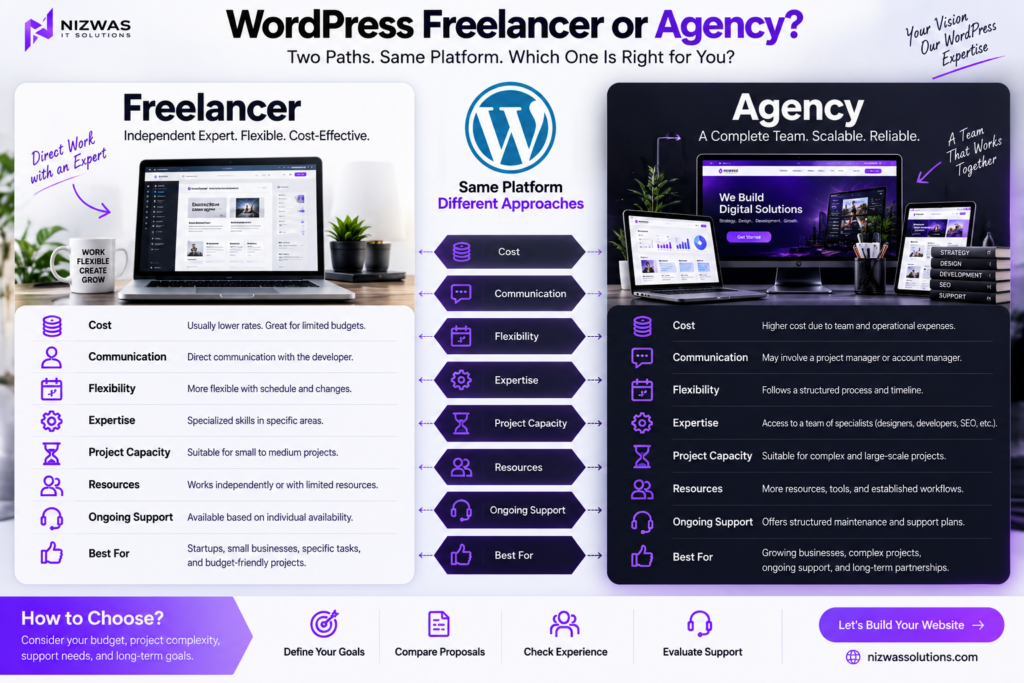
Freelancer vs Agency: Quick Comparison
| Factor | WordPress Freelancer | WordPress Agency |
|---|---|---|
| Communication | Often direct communication with the developer | May involve a project manager or multiple team members |
| Pricing | May have lower overhead | May include team and project management costs |
| Personal attention | Depends on workload and working style | Depends on team structure and client process |
| Technical expertise | Depends on the individual’s skills | Depends on the expertise of the assigned team |
| Project capacity | Usually linked to individual availability | May have more people available for different tasks |
| Complex projects | May work independently or with partners | May coordinate several specialists |
| Ongoing support | Depends on the support arrangement | May offer structured support plans |
| Accountability | Usually centered on one professional | Depends on the contract and assigned responsibilities |
The important question isn’t whether you choose a freelancer or an agency. It’s whether your chosen partner can deliver what your business actually needs.
Why Does Choosing the Right WordPress Partner Matter?
Your website is more than a collection of web pages.
For many businesses, it is a source of enquiries, sales, bookings, customer information, and brand credibility.
A technical problem can affect more than the website itself.
For example:
- A broken enquiry form can result in missed leads.
- A poorly configured website migration can cause downtime.
- An unoptimized checkout can create friction for customers.
- Poorly structured pages can make content harder to navigate.
- Lack of maintenance can lead to compatibility or security problems.
The development partner you choose should understand the potential business impact of these issues.
A Website Project Should Have a Clear Purpose
Before hiring a developer, ask yourself:
What do I actually want this website to achieve?
Your answer might be:
- Generate enquiries for a service business.
- Sell products through WooCommerce.
- Improve the credibility of a new startup.
- Publish educational content.
- Support an existing sales team.
- Simplify bookings or registrations.
- Replace an outdated website.
Once your goal is clear, you can evaluate providers more effectively.
A developer who understands your business objective may be able to recommend a simpler or more suitable solution than someone who immediately starts discussing themes and plugins.
Question 1: How Complex Is Your Website Project?
The complexity of your project should influence your hiring decision.
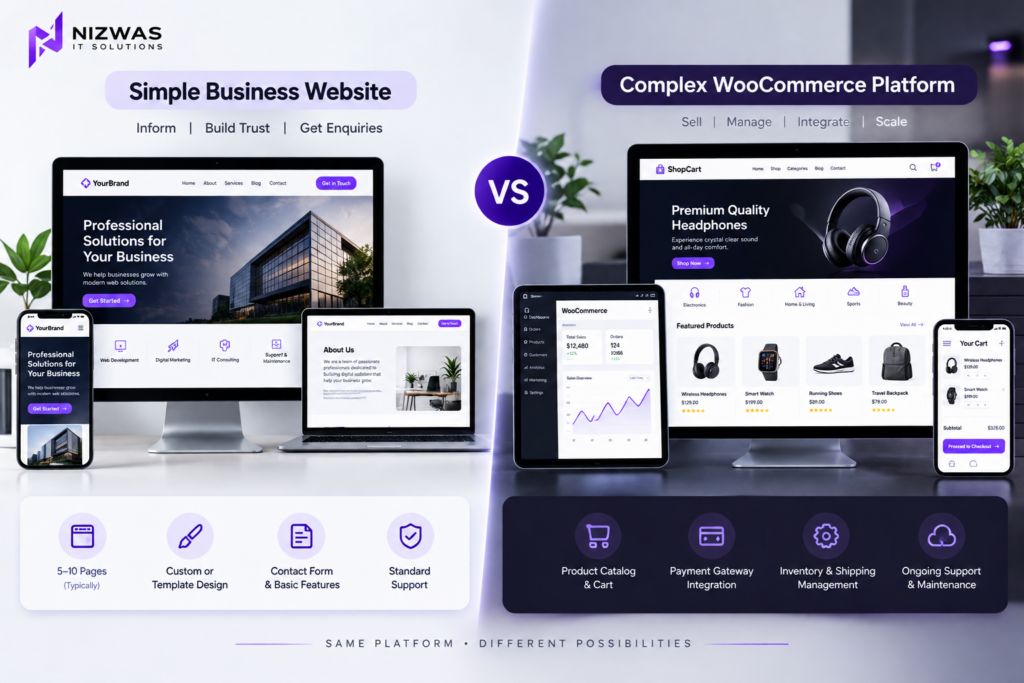
A five-page business website and a custom WooCommerce platform may both run on WordPress, but their technical requirements can be very different.
When a Freelancer May Be Suitable
A freelancer may be a practical option if you need:
- A small business website.
- A landing page.
- Elementor customization.
- A basic WordPress blog.
- Minor design changes.
- Routine content updates.
- A simple website redesign.
- A specific technical fix.
For example, imagine a local consultant who needs a professional website with six pages, a contact form, service descriptions, and a blog.
An experienced WordPress freelancer may be able to manage the entire project without requiring a larger team.
When an Agency May Be Suitable
An agency may be worth considering when your project involves:
- Multiple third-party integrations.
- Complex WooCommerce functionality.
- Custom API development.
- Large-scale website migration.
- Multiple language versions.
- Advanced performance requirements.
- Coordinated design, development, and SEO.
- Ongoing technical support.
- Several people working on the project.
For instance, an online retailer may need WooCommerce, payment processing, inventory synchronization, shipping integrations, and custom reporting.
That project may require several areas of expertise.
However, an experienced freelancer with the right technical partners may also be able to handle it.
Don’t judge a provider by its size. Judge it by its ability to manage your requirements..
Question 2: What Is Your Actual Website Budget?
Budget matters, but the cheapest proposal isn’t necessarily the most cost-effective option.
The total cost of a WordPress website depends on several factors, including the required functionality, design, content, integrations, testing, and support.
Why Freelancer and Agency Prices Differ
Pricing may vary because of:
- Project complexity.
- Developer experience.
- Custom design requirements.
- Number of pages.
- Third-party integrations.
- Content migration.
- Testing and quality assurance.
- Project management.
- Maintenance arrangements.
- Delivery deadlines.
An agency may have additional operational costs. A freelancer may have lower overhead but limited availability.
Neither model guarantees a better result.
Compare Project Scope, Not Just Price
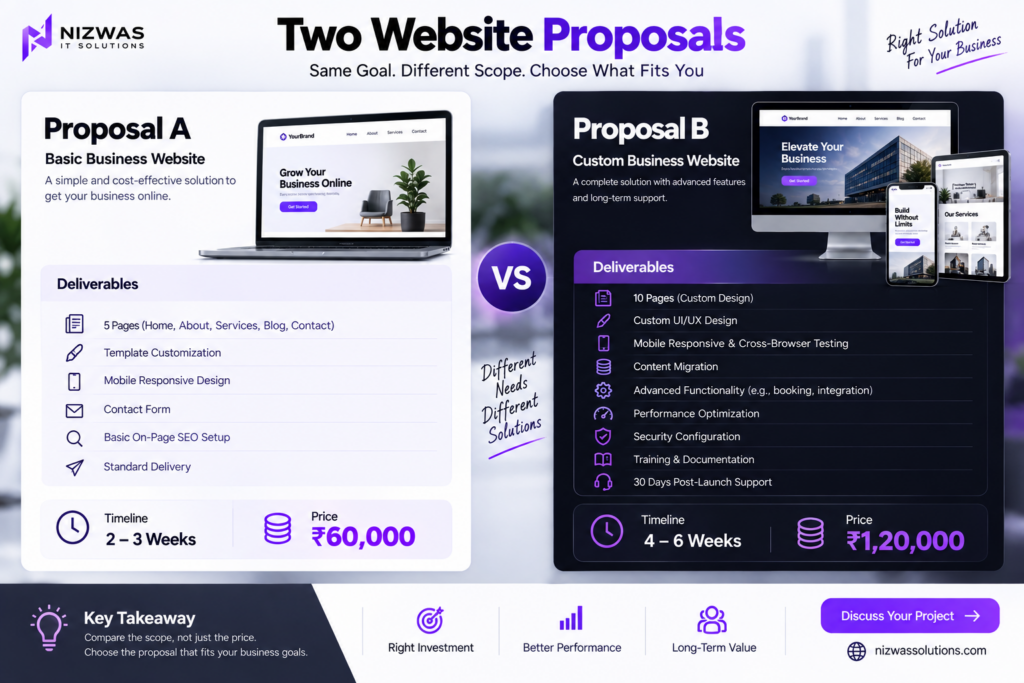
Imagine receiving two proposals for a website.
| Deliverable | Proposal A | Proposal B |
|---|---|---|
| Website type | Basic business website | Custom business website |
| Pages | 5 pages | 10 pages |
| Design | Template customization | Custom UI design |
| Content migration | Not included | Included |
| Performance testing | Basic checks | Detailed testing |
| Custom functionality | Not included | Included |
| Post-launch support | 7 days | 30 days |
| Price | ₹60,000 | ₹1,20,000 |
These are illustrative figures, not market-rate estimates.
The second proposal costs more, but it also offers a different scope.
Comparing the prices alone would not provide a meaningful assessment.
Questions to Ask About Pricing
Before accepting a proposal, clarify:
- What exactly is included?
- Are premium plugins included?
- Who provides the website content?
- How many design revisions are included?
- Are hosting and domain costs separate?
- Is SEO setup part of the project?
- Is migration included?
- What happens if additional functionality is requested?
- Is post-launch support included?
- Are taxes or third-party fees included?
A detailed proposal can prevent disagreements later.
Helpful Resource
If you’re planning a website project, Nizwas IT Solutions offers website development services tailored to different business requirements.
Explore our Website Design & Development Services.
Question 3: Do You Need Specialized Technical Expertise?
WordPress development can involve much more than installing a theme and creating pages.
Depending on your project, you may need expertise in several technical areas.
Important Skills to Evaluate
WordPress development
Relevant for custom themes, templates, plugins, and WordPress-specific functionality.
Frontend development
Useful for responsive layouts, HTML, CSS, JavaScript, and interactive user interfaces.
Backend development
Important when your website requires custom PHP functionality, database-related work, or complex integrations.
UI/UX design
Helps organize your website around the needs of your visitors.
Performance optimization
Involves investigating loading speed, inefficient code, caching, image delivery, and server response.
Technical SEO
Includes website structure, crawlability, internal linking, metadata, and other search-related technical considerations.
Security
Involves appropriate updates, access controls, backups, and security practices.
Is an Agency Automatically More Experienced?
No.
An agency may have several specialists, but you should find out who will actually work on your project.
An experienced freelancer may have deeper expertise in a specific area than a generalist agency.
Likewise, an agency may be better equipped to coordinate several disciplines.
What Should You Ask?
Instead of asking:
“Are you a freelancer or an agency?”
Ask:
“Have you completed a project with requirements similar to mine?”
Request relevant examples.
If your project requires a custom API integration, ask how the developer will handle:
- Authentication.
- Error handling.
- Testing.
- Data validation.
- Security.
- Future maintenance.
Relevant experience is more useful than a generic list of services.
Question 4: How Important Is Communication?
Communication can make or break a website project.
A typical website development process involves decisions about design, content, functionality, timelines, and budget.
If these decisions aren’t communicated clearly, misunderstandings can affect the final result.
Working With a Freelancer
One potential advantage is direct communication with the person building your website.
You may be able to discuss technical decisions without involving multiple people.
However, a freelancer may be managing several projects simultaneously.
Ask about availability before work begins.
Working With an Agency
An agency may assign a project manager to coordinate the work.
This can be helpful when designers, developers, SEO specialists, and other professionals are involved.
However, you should understand how technical questions reach the actual developer.
What Good Communication Looks Like
Your development partner should be able to explain:
- What has been completed.
- What is currently being worked on.
- What information is still required.
- Which problems have been identified.
- Whether the project is on schedule.
- Whether the budget has changed.
- Which decisions require your approval.
Questions to Ask
- Who will be my primary contact?
- How often will I receive updates?
- Where will project tasks be managed?
- How quickly should I expect responses?
- Who makes technical decisions?
- How are urgent problems handled?
At Nizwas IT Solutions, our published approach emphasizes direct communication and understanding business requirements before development begins. You can learn more about our approach through our company information page.
Good communication should make your project easier to understand, not harder.
Question 5: What Happens After Your Website Goes Live?
Launching your website is only one stage of its life.
WordPress websites rely on software, themes, plugins, hosting infrastructure, and other components that may require ongoing attention.
Updates can introduce compatibility issues. Hosting problems can affect availability. Business requirements can change over time.
What Might Ongoing Support Include?
Depending on your agreement, support may cover:
- WordPress updates.
- Plugin and theme updates.
- Website backups.
- Security monitoring.
- Performance improvements.
- Troubleshooting.
- Content updates.
- Hosting assistance.
- Website migrations.
- Technical consultations.
Not every website needs a monthly maintenance plan.
However, every business should know who will handle problems when they arise.
A Practical Example
Imagine that a plugin update causes your enquiry form to stop working.
You contact the person who built the website, but they are unavailable.
You now need to find someone else who understands the website’s configuration.
This situation can create unnecessary delays.
Before hiring a development partner, ask how they handle post-launch issues.
Questions to Ask About Maintenance
- Do you offer maintenance plans?
- What is included in ongoing support?
- What is the expected response time?
- Who handles emergency fixes?
- Are backups included?
- Is security monitoring available?
- Can another developer take over the website?
- What happens if the original developer is unavailable?
Nizwas IT Solutions offers Website Maintenance & Security Services that include website updates, backups, security-related work, and performance support, depending on the selected service.
A maintenance agreement should clearly explain what happens when your website needs attention.
Question 6: Who Owns Your Website?
Website ownership is one of the most overlooked topics in development projects.
Before signing a contract, understand who controls the website and its essential assets.
Important Assets to Discuss
| Asset | What to Clarify |
|---|---|
| Domain name | Who registers and controls the domain? |
| Hosting account | Can you access and manage the hosting? |
| WordPress admin | Will you receive administrator access? |
| Website content | Can you use and transfer your content? |
| Custom code | Who owns or can use the code created for the project? |
| Premium plugins | Who owns the licenses and renewal responsibilities? |
| Design files | Will you receive relevant design assets? |
| Analytics | Will you control your analytics and Search Console accounts? |
| Backups | Can you obtain a copy of the website? |
Why Ownership Matters
Suppose you want to move your website to a different hosting provider.
If you don’t have the required access credentials or clear contractual rights to the relevant assets, the migration may become complicated.
Paying for a website does not necessarily mean that every third-party component belongs to you.
Some themes, plugins, and software libraries have their own licensing terms.
A professional agreement should clarify these arrangements.
Questions to Ask Before Signing
- Will the domain be registered in my business’s name?
- Who controls the hosting account?
- Will I receive administrator access?
- Who owns the custom code?
- Are plugin licenses transferable?
- Can I move the website to another developer?
- Will I receive a final website backup?
- What happens if we stop working together?
Your website should remain manageable even if your development partnership changes.
Question 7: Can the Provider Understand Your Business Goals?
A technically impressive website isn’t necessarily an effective business website.
Your development partner should understand what visitors need to do when they arrive.
Consider These Two Examples
Example 1: A local plumbing company
Its website needs to generate service enquiries.
Important considerations may include:
- Clear service descriptions.
- Service-area information.
- Mobile-friendly contact options.
- Prominent enquiry forms.
- Trust signals.
- Easy navigation.
Example 2: An online clothing store
Its website needs to support product discovery and purchases.
Important considerations may include:
- Product information.
- Search and filtering.
- Shopping cart functionality.
- Checkout experience.
- Payment integration.
- Order management.
- Mobile usability.
Both businesses can use WordPress, but their requirements are different.
Questions Worth Asking
- What should our website accomplish?
- How would you structure our main pages?
- What information do you need from us?
- How will you approach mobile usability?
- How will you evaluate website performance?
- What should visitors do after reaching the homepage?
- How will we measure whether the website is helping the business?
A provider who asks meaningful business questions is more likely to understand the context behind your technical requirements.
Question 8: Can You Verify Their Previous Work?
A portfolio can help you understand a provider’s capabilities, but it should not be your only source of information.
A screenshot of a beautiful website doesn’t tell you everything about the development process.
What to Review
When evaluating a freelancer or agency, look for:
Relevant project examples
Have they worked on websites similar to yours?
Technical experience
Can they explain how they approached performance, integrations, or custom functionality?
Client references
Are there genuine client testimonials or references that you can verify?
Project process
Do they explain how requirements, testing, revisions, and launch are handled?
Documentation
Will you receive information about website access, maintenance, and future changes?
Communication
Do they respond clearly and address your actual questions?
Ask for a Realistic Demonstration
If you’re hiring someone to improve website performance, ask them to explain a real performance issue they have investigated.
If you’re hiring a WooCommerce developer, ask how they approach payment-related errors or checkout problems.
You don’t need to test every technical skill yourself.
But you should look for evidence that the provider understands the work they are offering.
Question 9: Do You Need a Long-Term Development Partner?
Some businesses need a website delivered and then managed internally.
Others need someone who can continue helping with improvements, troubleshooting, and technical development.
Neither arrangement is inherently better.
It depends on your business plans.
A Long-Term Partner May Be Useful If:
- Your website will continue to evolve.
- You expect to add new features.
- Your business depends heavily on online enquiries.
- You operate a WooCommerce store.
- You need regular technical maintenance.
- You expect ongoing integrations.
- You don’t have in-house technical expertise.
A One-Time Project May Be Enough If:
- Your website has a clearly defined scope.
- Your team can manage content updates.
- You have an internal maintenance process.
- You only need a specific redesign or technical fix.
- You have a separate support arrangement.
Before hiring, consider where you want your website to be six or twelve months after launch.
A provider who understands your longer-term plans may be able to recommend an approach that avoids unnecessary rework.
Freelancer or Agency: Which Option Fits Your Project?
There is no universal answer.
The right choice depends on your project, budget, technical requirements, and expectations.
| Your Situation | Factors to Consider |
|---|---|
| Simple business website | Relevant experience, price, communication, and delivery scope |
| Landing page project | Design skills, conversion requirements, and turnaround time |
| Custom WordPress development | Technical depth, code quality, testing, and documentation |
| WooCommerce store | Checkout, payment integration, performance, and ongoing support |
| Website migration | Backup strategy, testing, redirects, and technical experience |
| Ongoing maintenance | Availability, response times, and clearly defined responsibilities |
| Complex multi-specialist project | Coordination, project management, and team expertise |
These are general guidelines.
A freelancer can manage a complex project, and an agency can build a simple website successfully.
Evaluate the actual capabilities of the provider you’re considering.
How to Choose a WordPress Development Partner: A 5-Step Process
Step 1: Define Your Business Objective
Write down what your website should accomplish.
For example:
“We want to make it easier for potential customers to understand our services and submit an enquiry.”
A clear objective helps your development partner make more relevant recommendations.
Step 2: Create a Project Brief
Include:
- Required pages.
- Website features.
- Design preferences.
- Target audience.
- Content requirements.
- Budget range.
- Expected timeline.
- Maintenance expectations.
Step 3: Shortlist Relevant Providers
Look for freelancers or agencies with experience in your type of project.
Review their portfolio, technical knowledge, communication, and available services.
Step 4: Compare Detailed Proposals
Ask providers to explain:
- Project scope.
- Deliverables.
- Timeline.
- Pricing.
- Revision policy.
- Ownership arrangements.
- Support options.
Step 5: Sign a Clear Agreement
Before development begins, document:
- Responsibilities.
- Payment terms.
- Project milestones.
- Access requirements.
- Ownership arrangements.
- Change requests.
- Support terms.
A clear agreement protects both the client and the development provider.
Common Mistakes to Avoid
Choosing Only on Price
A low quote may exclude important work.
Compare the full scope of the project.
Hiring Without a Clear Brief
Unclear requirements can create confusion about timelines, costs, and deliverables.
Assuming an Agency Is Always More Capable
Company size does not automatically indicate technical quality.
Ignoring Website Ownership
Make sure you understand who controls your domain, hosting, and website assets.
Forgetting About Maintenance
Discuss what happens after launch.
Expecting Guaranteed SEO Results
No freelancer or agency can honestly guarantee a particular Google ranking.
SEO depends on many factors, including relevance, content quality, competition, and technical conditions.
Failing to Verify Experience
Ask for relevant examples and explanations of previous work.
How Nizwas IT Solutions Approaches WordPress Projects
At Nizwas IT Solutions, we focus on WordPress development and related digital solutions for businesses that need practical, maintainable websites.
Our published services include:
WordPress Development
Business websites, custom functionality, themes, plugins, and integrations based on project requirements.
Website Design and Development
Responsive websites designed around business goals, usability, and technical requirements.
Performance Optimization
Investigating website speed, caching, image optimization, and other technical performance factors.
Website Maintenance and Security
Support for updates, backups, troubleshooting, security-related improvements, and ongoing website care.
SEO-Friendly Website Foundations
Attention to website structure, technical SEO considerations, and content organization during development.
Business-Focused Digital Solutions
Helping businesses identify appropriate technology and digital solutions for their specific requirements.
You can explore our WordPress and website development services or visit Nizwas IT Solutions to discuss your project.
Our approach emphasizes understanding the business requirement first, maintaining direct communication, and recommending practical solutions.
The right solution isn’t necessarily the most expensive one.
Final Thoughts: WordPress Freelancer or Agency?
Choosing a WordPress freelancer or agency is an important business decision, particularly when your website plays a role in generating enquiries, selling products, or building customer trust.
The best choice depends on your actual requirements.
Start by understanding your project.
Then evaluate relevant experience, pricing, communication, ownership, and long-term support.
A freelancer may provide the specialist expertise and personal attention your project needs.
An agency may offer the team structure and range of services required for a more complex project.
Neither option is automatically right for every business.
The goal is to find a development partner who can deliver a website that works for your business today and remains manageable as your requirements change.
Before you sign a contract, ask the right questions. A clear understanding of the project can be just as valuable as the development work itself.
Planning Your Next WordPress Project?
Nizwas IT Solutions helps businesses explore WordPress development, website optimization, maintenance, and other digital solutions.
Whether you’re starting from scratch or improving an existing website, we welcome the opportunity to understand your requirements.
Have a project in mind? Get in touch through our website.
Have you worked with a WordPress freelancer or agency before?
What mattered most to you pricing, communication, technical expertise, or ongoing support?
Share your experience in the comments.
Frequently Asked Questions
Either option may be suitable. A freelancer can be practical for a straightforward website with a clearly defined scope. An agency may be useful if you need multiple services, ongoing support, or more complex functionality. Compare relevant experience, pricing, communication, and deliverables before deciding.
A freelancer may have lower overhead, which can affect pricing. However, costs depend on project complexity, experience, scope, and support requirements. Some freelancers charge more than agencies for specialized work. Compare complete proposals rather than relying on the provider’s category.
Yes. An experienced WordPress freelancer can create professional business websites, including responsive layouts, custom designs, integrations, and specialized functionality. Review relevant projects and ask about their development and testing process before hiring.
An agency may be useful when your project involves multiple disciplines, complex integrations, coordinated development, or ongoing technical support. However, an experienced freelancer or small development team may also handle these requirements successfully.
Ask about relevant experience, project scope, pricing, timelines, communication, testing, website ownership, security, maintenance, and post-launch support. Make sure you understand what is included in the agreement.
Not automatically. SEO outcomes depend on the expertise and work delivered, not simply whether you hire an agency or freelancer. Evaluate the provider’s technical SEO knowledge, content approach, relevant experience, and willingness to explain recommendations.
There is no single price for WordPress development. Costs depend on the website’s size, design, functionality, integrations, content requirements, and support arrangements. Request detailed proposals based on your actual requirements.
Yes. Nizwas IT Solutions offers WordPress development, website design, performance optimization, maintenance, security-related services, and other digital solutions. Visit nizwassolutions.com to discuss your requirements.