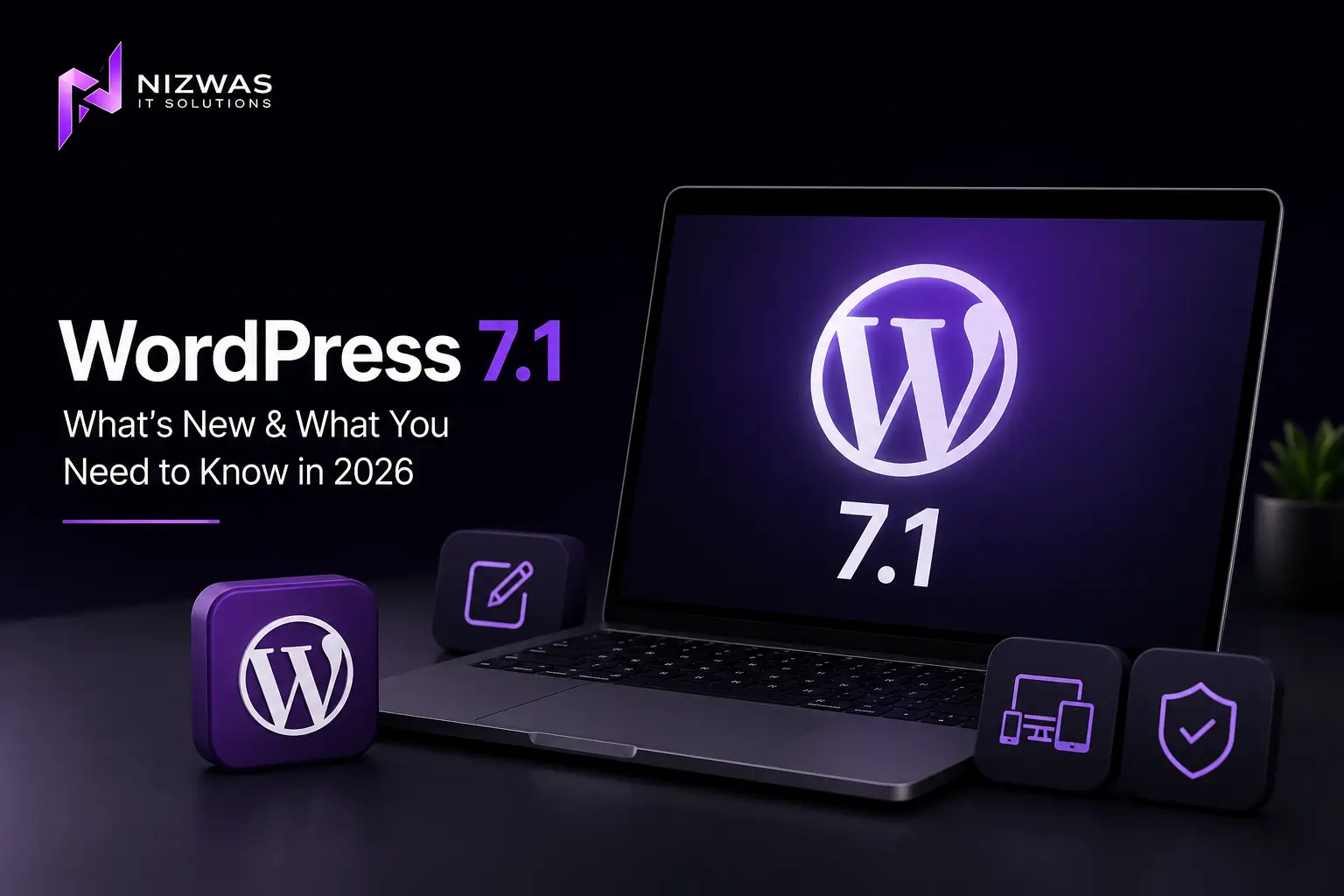
WordPress 7.1 Is Here — What Does the Update Actually Mean?
WordPress 7.1 was released on August 19, 2026, bringing a collection of improvements aimed at making WordPress easier to design, manage, edit and extend. The release is particularly interesting for business owners because many of its changes are focused on practical website management rather than features that only developers will notice.
If you manage a WordPress website, you may be wondering whether this is an update you should install immediately or whether it is better to wait.
The answer depends on your website.
A simple brochure website with a well-maintained theme and regularly updated plugins may have a relatively straightforward upgrade. A WooCommerce store, membership website, Elementor website, custom WordPress installation or website with several third-party integrations needs more careful testing.
That distinction is important because a WordPress core update does not exist in isolation. Your website is a combination of WordPress core, themes, plugins, hosting, caching, CDN configuration, PHP, database settings and custom code.
WordPress 7.1 introduces improvements in several areas:
- Responsive styling
- Media handling
- Image editing
- WordPress Notes
- Editor navigation
- New blocks
- Accessibility
- Developer APIs
- Performance-related improvements
- Administration and usability
The official WordPress release documentation confirms that WordPress 7.1 can be installed through the WordPress Dashboard under Dashboard → Updates, with additional documentation available for sites requiring a more controlled upgrade process.
For businesses, the important question is therefore not simply, “What features were added?”
A better question is:
What changes could affect my website, its performance, compatibility, SEO and day-to-day management?
That is what we will look at in this guide.
If you are deciding whether WordPress itself is still the right platform for your business, our guide on WordPress vs Custom Website explains the practical differences between WordPress and custom development.
The Biggest WordPress 7.1 Features
Responsive styling without relying as heavily on custom CSS
One of the most important changes in WordPress 7.1 is the expansion of responsive styling controls.
Modern websites have to work across desktops, tablets and smartphones. Previously, achieving specific responsive behaviours in WordPress could require custom CSS, theme-specific controls or additional plugins.
WordPress 7.1 brings more responsive controls directly into the Site Editor. Website creators can adjust how certain blocks behave at different viewport sizes and preview changes while working on a design.
For website owners, this can make responsive design easier to manage.
For developers, it can reduce the amount of custom code needed for certain layouts.
For businesses, the practical benefit is potentially simpler website maintenance.
Responsive design is particularly important because mobile visitors are not simply using a smaller version of a desktop website. They interact with menus, forms, buttons, images and content differently.
A website that looks excellent on a desktop but creates problems on mobile can lose enquiries even if its desktop design looks impressive.
Better media processing
WordPress 7.1 also improves how media is handled.
The release introduces client-side processing for certain image operations, meaning compression, resizing and thumbnail generation can happen in the browser rather than placing the entire workload on the server. WordPress also adds support for modern formats including AVIF and HEIC, along with HDR gain maps.
This matters because large images are one of the common causes of slow websites.
Moving some processing to the browser can help reduce server-side pressure and avoid problems associated with PHP memory limits or upload timeouts.
However, this does not mean that every WordPress website will automatically become fast after upgrading to 7.1.
Website performance still depends on:
- Hosting
- Server response time
- Image dimensions
- Caching
- JavaScript
- CSS
- Plugins
- Database queries
- CDN configuration
- Third-party scripts
- Theme architecture
If your website is already struggling with speed, upgrading WordPress should be part of a broader technical review rather than treated as a complete performance solution.
Our detailed guide on why WordPress websites become slow explains the different causes that need to be investigated.
Improved image editing
WordPress 7.1 introduces an improved inline cropping experience, giving users more flexibility when editing images inside WordPress.
This may appear like a small improvement, but it matters for teams that regularly publish content.
Marketing teams and business owners often need to adjust an image quickly without opening another image-editing application.
Small improvements like this can reduce friction in everyday website management.
New Playlist and Tabs blocks
WordPress 7.1 introduces new blocks, including a Playlist block and Tabs block. The Playlist block can be used to present collections of audio files and can include waveform visualisation. The Tabs block allows related content to be organised into separate clickable panels.
For publishers, educators, podcasters and content-heavy businesses, these native blocks can reduce the need for additional plugins for certain use cases.
Fewer unnecessary plugins can potentially make a website easier to maintain, although plugin decisions should always be based on the actual requirements of the website.
Improved Notes and collaboration
WordPress 7.1 expands Notes with features such as inline formatting, @mentions, multiple conversations and notes attached to selected text.
This is useful for teams working on website content.
For example, an editor can leave feedback about a particular section instead of sending a separate message describing where a problem exists.
That may seem like a small workflow improvement, but collaboration becomes increasingly important as websites involve multiple people — business owners, writers, designers, SEO specialists and developers.
Persistent admin navigation
WordPress 7.1 also improves navigation by keeping the WordPress admin bar available across editors. The goal is to provide a more consistent experience while moving between different editing environments.
For people who spend significant time inside WordPress, this can make the dashboard feel more coherent.
WordPress 7.1, SEO, Performance and Security
A common mistake is to assume that a new WordPress version automatically improves SEO rankings.
It doesn’t.
WordPress 7.1 provides technical improvements that can support a better website experience, but rankings still depend on content quality, search intent, website architecture, technical SEO, authority, relevance, usability and many other factors.
Does WordPress 7.1 improve SEO?
Indirectly, it can help.
Responsive styling can make it easier to create mobile-friendly layouts.
Improved media handling can support better image workflows.
Better content editing tools can make it easier to maintain useful pages.
Developer improvements can help create cleaner and more maintainable implementations.
But upgrading WordPress alone will not move a website from page 5 to page 1.
SEO should be considered as part of the complete website architecture.
For example, a properly developed WordPress website should consider:
- Crawlability
- Indexing
- Internal linking
- Canonical URLs
- XML sitemaps
- Structured data
- Metadata
- Page speed
- Mobile usability
- Content structure
- Search intent
- Conversion paths
Nizwas’ website development and SEO services take this broader approach rather than treating SEO as simply installing an SEO plugin.
Performance improvements need context
WordPress 7.1 includes changes related to media processing and speculative loading.
The WordPress development roadmap also describes changes to speculative loading, with the default eagerness moving from conservative toward moderate when both object caching and page caching are detected.
This is an important distinction.
Performance features are useful when the underlying hosting and caching environment is configured correctly.
A poorly configured cache can still create problems.
An overloaded server can still be slow.
A heavy page builder can still generate excessive frontend resources.
A large number of plugins can still increase complexity.
So after upgrading, you should check real performance rather than assuming the site is faster.
Test:
Homepage → Important service pages → Blog → Contact form → Login/admin → WooCommerce pages, if applicable.
Also review Core Web Vitals and real-user performance where sufficient data is available.
Security and compatibility
Every major WordPress update should be treated as a compatibility exercise.
Before updating a production website:
- Create a complete backup.
- Confirm the backup can actually be restored.
- Check the PHP version.
- Update plugins and themes where appropriate.
- Check plugin compatibility.
- Test on staging if available.
- Update WordPress.
- Test the frontend.
- Test forms.
- Test ecommerce functionality.
- Check caching.
- Review error logs.
This is especially important for websites using caching and CDN integrations.
Nizwas has already documented a real WordPress 7.1 compatibility issue involving WP Rocket and its Cloudflare integration. The affected configuration could produce a PHP fatal error, and the issue was addressed by WP Rocket in version 3.23.2.2 according to the documentation cited in Nizwas’ technical guide.
This is exactly why blindly clicking Update on a business-critical website is not always the best approach.
A WordPress update can be technically correct while a third-party plugin creates the actual failure.
Should You Upgrade to WordPress 7.1?
For most actively maintained WordPress websites, staying on a supported current version is preferable to remaining indefinitely on an old version.
But the correct upgrade process matters.
Before upgrading WordPress 7.1
Start with a backup.
Do not rely on the assumption that your hosting provider’s backup is sufficient. Know where the backup is stored and how it can be restored.
Then check your important plugins.
Pay particular attention to:
- Caching plugins
- Security plugins
- Page builders
- WooCommerce
- Payment gateways
- SEO plugins
- CDN integrations
- Membership plugins
- Custom plugins
- Custom themes
- API integrations
A small five-page business website may need only a short compatibility check.
A WooCommerce store with custom checkout functionality may need significantly more testing.
Use staging when possible
For business-critical websites, staging is one of the safest ways to test a WordPress update.
Create a staging copy.
Update WordPress there.
Then check:
Design: Are layouts still correct?
Functionality: Do forms and interactive elements work?
Navigation: Do menus and links work?
SEO: Are metadata, canonical tags and indexing controls unchanged?
Performance: Did loading behaviour change?
Commerce: Can customers add products, checkout and complete payment?
Integrations: Are APIs and external services working?
Only after these checks should the production update be considered.
Don’t confuse an update with a website rebuild
WordPress 7.1 is a core software update. It does not mean that businesses need a new website.
If your existing website is working well, has a maintainable theme, compatible plugins and good performance, upgrading may be all that is necessary.
If the website is outdated, slow, difficult to manage or dependent on years of accumulated customisations, the update may reveal deeper problems.
In that situation, the right question is not:
“Should I install WordPress 7.1?”
It is:
“Is my current website architecture still suitable for the business?”
Our WordPress website cost guide explains why the cost of a WordPress website varies significantly depending on design, functionality, integrations, SEO, ecommerce and development requirements.
What about Elementor websites?
Elementor-based websites should be tested after the WordPress 7.1 upgrade, particularly where custom code, third-party Elementor extensions or heavily customised templates are involved.
The same principle applies to any page builder.
The core WordPress update may work correctly while a third-party extension causes a visual or functional problem.
For a professional WordPress website, compatibility testing should therefore be part of your maintenance process rather than something you do only after something breaks.
What Website Owners Should Do After Installing WordPress 7.1
Once WordPress 7.1 is installed, don’t immediately assume everything is finished.
Spend some time checking the website.
1. Check the homepage
Look at the desktop and mobile versions.
Check:
- Header
- Navigation
- Hero section
- Images
- Buttons
- Forms
- Footer
- Animations
- Responsive spacing
2. Check important landing pages
Open your highest-value pages.
For a service business, these may include:
- WordPress development
- Website design
- SEO
- Ecommerce
- Contact
- Industry pages
- Location pages
Make sure the content and calls to action remain intact.
3. Check your SEO
Open your SEO plugin and review important pages.
Check:
- SEO titles
- Meta descriptions
- Canonical URLs
- Robots directives
- Schema
- Open Graph data
- XML sitemap
- Internal links
Do not change perfectly working SEO settings simply because you upgraded WordPress.
4. Check website performance
Run performance tests after clearing the appropriate cache.
If you use multiple caching layers, clear them carefully rather than repeatedly purging everything on production without understanding how the system works.
Check:
- TTFB
- Largest Contentful Paint
- Interaction to Next Paint
- Cumulative Layout Shift
- Image sizes
- JavaScript
- CSS
- Server response
Remember that performance results can change depending on location, device and network conditions.
5. Check security
Review:
- WordPress core version
- Plugin versions
- Theme version
- PHP version
- SSL
- Administrator accounts
- Backups
- Security headers
- Firewall/CDN configuration
- Login protection
Security is not something that can be completed once and forgotten.
It is an ongoing maintenance responsibility.
6. Keep an eye on errors
After an upgrade, check your server logs and WordPress error logs if something behaves unexpectedly.
A blank page, 500 error, PHP warning, broken form or strange frontend behaviour can often point directly toward a plugin, theme or custom-code compatibility problem.
If you encounter a fatal error involving WP Rocket after upgrading, our dedicated WordPress 7.1 + WP Rocket troubleshooting guide covers that specific compatibility issue in more detail.
Final thoughts
WordPress 7.1 is more than a collection of small interface changes.
The release improves responsive design controls, media handling, editing, collaboration, accessibility, administration and developer capabilities.
For website owners, the biggest takeaway is not that every website suddenly needs to be redesigned.
It is that WordPress continues to evolve toward a more capable visual editing and development platform.
If your website is properly maintained, WordPress 7.1 gives you useful new capabilities to work with.
If your website has not been maintained for a long time, however, the update is a good reason to review its plugins, theme, hosting, performance, security and overall architecture.
A successful WordPress upgrade should leave the business with a website that is not only running the latest software, but is also stable, secure, fast, accessible, search-friendly and easy to maintain.
That is the approach we recommend at Nizwas IT Solutions: technology should support the business rather than become another problem for the business owner to manage. Our broader business technology and digital solutions cover WordPress development, performance, SEO, ecommerce, security and ongoing website support.
Frequently Asked Questions
WordPress 7.1 is the latest major WordPress release, officially launched on August 19, 2026. It introduces improvements to responsive styling, media handling, Notes, editing, blocks, accessibility, administration and developer APIs.
The major improvements include responsive styling controls, improved media processing, better image editing, enhanced Notes, persistent admin navigation, the Playlist and Tabs blocks, accessibility improvements and expanded developer APIs.
Generally, keeping an actively maintained website on a current supported WordPress version is advisable. However, businesses should back up the website and check plugin, theme, hosting and custom-code compatibility before updating production.
WordPress 7.1 includes improvements that can support responsive design, media workflows and website usability, but the update itself does not guarantee higher Google rankings. SEO still depends on content, technical SEO, website architecture, relevance, authority, performance and user experience.
Some changes can improve media processing and website performance, but WordPress 7.1 does not automatically fix slow hosting, oversized images, heavy plugins, excessive JavaScript or poor caching. Performance should be tested after upgrading.
WooCommerce websites should be tested carefully because stores often depend on payment gateways, extensions, custom checkout functionality, shipping integrations and other plugins. A staging environment is recommended for important ecommerce websites.
Yes. WordPress core updates can expose compatibility problems with plugins, themes, custom code or third-party integrations. This is why backups and compatibility testing are important before updating.
Create a verified backup, check your plugins and theme, review PHP compatibility, test the website on staging when possible and verify critical functionality before applying the update to production.
No. You do not need to replace your theme simply because WordPress 7.1 is available. Whether a theme needs changes depends on its architecture, compatibility and how heavily it has been customised.
Yes. Nizwas provides WordPress development, website maintenance, security, performance optimization and technical support. Nizwas WordPress and website services